Ch. 3 - Derivatives
Briggs - Calculus: Early Transcendentals 3rd Edition
Briggs3rd EditionCalculus: Early TranscendentalsISBN: 9780136847243Non è quello che usi tu?Cambia libro di testo
Capitolo 3, Problema 3.11.14a

Shrinking isosceles triangle The hypotenuse of an isosceles right triangle decreases in length at a rate of 4 m/s.
a. At what rate is the area of the triangle changing when the legs are 5 m long?

Guida verificata passo dopo passo
1
Identify the relationship between the hypotenuse and the legs of the isosceles right triangle. In an isosceles right triangle, the hypotenuse \( c \) is related to the legs \( a \) by the equation \( c = a\sqrt{2} \).
Differentiate the equation \( c = a\sqrt{2} \) with respect to time \( t \) to find the relationship between the rates of change of the hypotenuse and the legs. This gives \( \frac{dc}{dt} = \sqrt{2} \frac{da}{dt} \).
Substitute the given rate of change of the hypotenuse \( \frac{dc}{dt} = -4 \) m/s into the differentiated equation to solve for \( \frac{da}{dt} \), the rate of change of the legs.
Use the formula for the area \( A \) of an isosceles right triangle, \( A = \frac{1}{2}a^2 \), and differentiate it with respect to time \( t \) to find \( \frac{dA}{dt} \). This gives \( \frac{dA}{dt} = a \frac{da}{dt} \).
Substitute \( a = 5 \) m and the previously calculated \( \frac{da}{dt} \) into the differentiated area formula to find the rate at which the area is changing, \( \frac{dA}{dt} \).

Risposta video verificata per un problema simile:

Questa soluzione video è stata consigliata dai nostri tutor come utile per risolvere questo problema.
Durata del video:
4m

Concetti chiave

Ecco i concetti essenziali che devi comprendere per rispondere correttamente alla domanda.

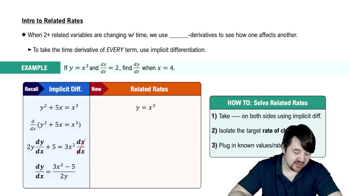
Related Rates

Related rates involve finding the rate at which one quantity changes in relation to another. In this problem, we need to relate the rate of change of the hypotenuse to the rate of change of the area of the triangle. This requires the use of derivatives to express how changes in one variable affect another over time.
Video consigliato:
Percorso guidato
04:16
Intro To Related Rates

Area of a Triangle

The area of a triangle can be calculated using the formula A = (1/2) * base * height. For an isosceles right triangle, the legs are equal, and both serve as the base and height. Understanding how to express the area in terms of the leg length is crucial for determining how the area changes as the triangle shrinks.
Video consigliato:
Percorso guidato
07:59
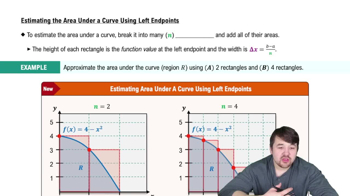
Estimating the Area Under a Curve Using Left Endpoints

Pythagorean Theorem

The Pythagorean theorem states that in a right triangle, the square of the hypotenuse is equal to the sum of the squares of the other two sides. This theorem is essential for relating the lengths of the legs of the triangle to the hypotenuse, allowing us to express the leg lengths in terms of the hypotenuse as it changes over time.
Video consigliato:
Percorso guidato
06:11
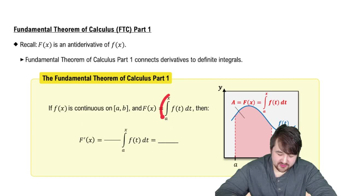
Fundamental Theorem of Calculus Part 1