Ch. 3 - Derivatives
Briggs - Calculus: Early Transcendentals 3rd Edition
Briggs3rd EditionCalculus: Early TranscendentalsISBN: 9780136847243Non è quello che usi tu?Cambia libro di testo
Capitolo 3, Problema 3.10.46a

{Use of Tech} Angle of elevation A small plane, moving at 70 m/s, flies horizontally on a line 400 meters directly above an observer. Let θ be the angle of elevation of the plane (see figure). <IMAGE>


a. What is the rate of change of the angle of elevation dθ/dx when the plane is x=500 m past the observer?

Guida verificata passo dopo passo
1
First, understand the scenario: The plane is flying horizontally at a constant speed of 70 m/s, 400 meters above the observer. The angle of elevation θ is the angle between the line of sight from the observer to the plane and the horizontal line from the observer.
To find the rate of change of the angle of elevation (dθ/dx), we need to relate θ to the horizontal distance x from the observer. Use the tangent function: tan(θ) = opposite/adjacent = 400/x.
Differentiate both sides of the equation tan(θ) = 400/x with respect to time t. Use implicit differentiation: d(tan(θ))/dt = d(400/x)/dt.
Apply the chain rule: sec²(θ) * (dθ/dt) = -400/x² * (dx/dt). Here, dx/dt is the speed of the plane, which is 70 m/s.
Substitute x = 500 m and dx/dt = 70 m/s into the differentiated equation to solve for dθ/dt. Remember that sec²(θ) = 1/cos²(θ), and you can find cos(θ) using the right triangle relationship: cos(θ) = x/√(x² + 400²).

Risposta video verificata per un problema simile:

Questa soluzione video è stata consigliata dai nostri tutor come utile per risolvere questo problema.
Durata del video:
5m

Concetti chiave

Ecco i concetti essenziali che devi comprendere per rispondere correttamente alla domanda.

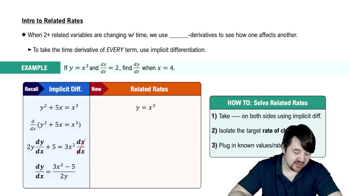
Related Rates

Related rates involve finding the rate at which one quantity changes in relation to another. In this problem, we need to determine how the angle of elevation θ changes as the horizontal distance x from the observer changes. This concept is essential for applying implicit differentiation to relate the rates of change of different variables.
Video consigliato:
Percorso guidato
04:16
Intro To Related Rates

Trigonometric Functions

Trigonometric functions, particularly tangent in this context, relate the angle of elevation to the opposite and adjacent sides of a right triangle. The angle θ can be expressed as θ = arctan(opposite/adjacent), where the opposite side is the height of the plane and the adjacent side is the horizontal distance from the observer. Understanding these relationships is crucial for deriving the necessary equations.
Video consigliato:
Percorso guidato
6:04
Introduction to Trigonometric Functions

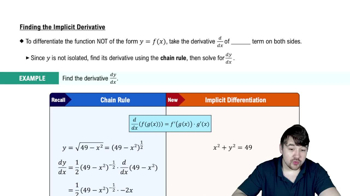
Implicit Differentiation

Implicit differentiation is a technique used to differentiate equations where the variables are not isolated. In this scenario, we will differentiate the equation relating θ, x, and the height of the plane to find dθ/dx. This method allows us to find the rate of change of the angle of elevation with respect to the horizontal distance without explicitly solving for θ.
Video consigliato:
Percorso guidato
05:14
Finding The Implicit Derivative