Ch. 3 - Derivatives
Briggs - Calculus: Early Transcendentals 3rd Edition
Briggs3rd EditionCalculus: Early TranscendentalsISBN: 9780136847243Non è quello che usi tu?Cambia libro di testo
Capitolo 3, Problema 3.10.67

67–78. Derivatives of inverse functions Consider the following functions (on the given interval, if specified). Find the derivative of the inverse function.


f(x) = 3x-4

Guida verificata passo dopo passo
1
First, understand that if f(x) is a function, then its inverse, denoted as f^(-1)(x), is a function such that f(f^(-1)(x)) = x and f^(-1)(f(x)) = x.
To find the derivative of the inverse function, we use the formula: (f^(-1))'(y) = 1 / f'(x), where y = f(x).
Given the function f(x) = 3x - 4, we first need to find its derivative, f'(x). Differentiate f(x) with respect to x to get f'(x) = 3.
Now, apply the formula for the derivative of the inverse function: (f^(-1))'(y) = 1 / f'(x). Since f'(x) = 3, we have (f^(-1))'(y) = 1 / 3.
Thus, the derivative of the inverse function f^(-1)(x) is a constant value, 1/3, for all x in the domain of the inverse function.

Risposta video verificata per un problema simile:

Questa soluzione video è stata consigliata dai nostri tutor come utile per risolvere questo problema.
Durata del video:
2m

Concetti chiave

Ecco i concetti essenziali che devi comprendere per rispondere correttamente alla domanda.

Inverse Functions

An inverse function essentially reverses the effect of the original function. If a function f takes an input x and produces an output y, the inverse function f⁻¹ takes y back to x. Understanding how to find and work with inverse functions is crucial for solving problems involving derivatives of these functions.
Video consigliato:
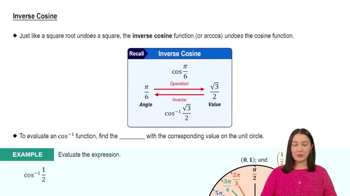
4:49
Inverse Cosine

Derivative of a Function

The derivative of a function measures how the function's output changes as its input changes. It is defined as the limit of the average rate of change of the function over an interval as the interval approaches zero. This concept is fundamental in calculus, as it provides the slope of the tangent line to the function at any given point.
Video consigliato:
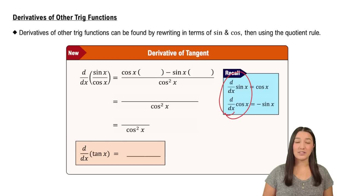
06:30
Derivatives of Other Trig Functions

Derivative of Inverse Functions Theorem

The Derivative of Inverse Functions Theorem states that if f is a differentiable function and f'(x) is non-zero, then the derivative of its inverse function f⁻¹ at a point y is given by f⁻¹'(y) = 1 / f'(f⁻¹(y)). This theorem is essential for finding the derivative of an inverse function, as it connects the derivatives of the original and inverse functions.
Video consigliato:
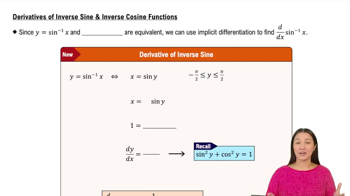
07:26
Derivatives of Inverse Sine & Inverse Cosine