Ch. 3 - Derivatives
Briggs - Calculus: Early Transcendentals 3rd Edition
Briggs3rd EditionCalculus: Early TranscendentalsISBN: 9780136847243Non è quello che usi tu?Cambia libro di testo
Capitolo 3, Problema 72b

The right-sided and left-sided derivatives of a function at a point aa are given by f+′(a)=limh→0+f(a+h)−f(a)hf_{+}^{\(\prime\)}\(\left\)(a\(\right\))={\(\displaystyle\)\(\lim\)_{h\(\to\)0^{+}}{\(\frac{f(a+h)-f(a)}{h}\)}} and f−′(a)=limh→0−f(a+h)−f(a)hf_{-}^{\(\prime\)}\(\left\)(a\(\right\))={\(\displaystyle\)\(\lim\)_{h\(\to\)0^{-}}{\(\frac{f(a+h)-f(a)}{h}\)}}, respectively, provided these limits exist. The derivative f′(a)f^{\(\prime\)}\(\left\)(a\(\right\)) exists if and only if f+′(a)=f−′(a)f_{+}^{\(\prime\)}\(\left\)(a\(\right\))=f_{-}^{\(\prime\)}\(\left\)(a\(\right\)).
Compute f+′(a)f_{+}^{\(\prime\)}\(\left\)(a\(\right\)) and f−′(a)f_{-}^{\(\prime\)}\(\left\)(a\(\right\)) at the given point aa.
f(x)={4−x2 if x≤12x+1 if x>1f(x)=\(\begin{cases}\)4-x^2~\(\text{if}\)~x\(\leq{1}\)\\2x+1~\(\text{if}\)~x\(\gt{1}\)\(\end{cases}\); a=1a=1

Guida verificata passo dopo passo
1
Identify the piecewise function given: f(x) = 4 - x^2 for x ≤ 1 and f(x) = 2x + 1 for x > 1. We need to compute the right-sided and left-sided derivatives at a = 1.
Compute the left-sided derivative f_{-}^{\(\text{prime}\)}(1) using the limit definition: f_{-}^{\(\text{prime}\)}(1) = \(\lim\)_{h \(\to\) 0^{-}} \(\frac{f(1+h) - f(1)}{h}\). Since x ≤ 1, use f(x) = 4 - x^2. Substitute f(1) = 4 - 1^2 = 3 and f(1+h) = 4 - (1+h)^2.
Simplify the expression for the left-sided derivative: f_{-}^{\(\text{prime}\)}(1) = \(\lim\)_{h \(\to\) 0^{-}} \(\frac{(4 - (1+h)^2) - 3}{h}\). Expand (1+h)^2 to get 1 + 2h + h^2, and simplify the numerator.
Compute the right-sided derivative f_{+}^{\(\text{prime}\)}(1) using the limit definition: f_{+}^{\(\text{prime}\)}(1) = \(\lim\)_{h \(\to\) 0^{+}} \(\frac{f(1+h) - f(1)}{h}\). Since x > 1, use f(x) = 2x + 1. Substitute f(1) = 3 and f(1+h) = 2(1+h) + 1.
Simplify the expression for the right-sided derivative: f_{+}^{\(\text{prime}\)}(1) = \(\lim\)_{h \(\to\) 0^{+}} \(\frac{(2(1+h) + 1) - 3}{h}\). Simplify the numerator and evaluate the limit to find f_{+}^{\(\text{prime}\)}(1).

Risposta video verificata per un problema simile:

Questa soluzione video è stata consigliata dai nostri tutor come utile per risolvere questo problema.
Durata del video:
7m

Concetti chiave

Ecco i concetti essenziali che devi comprendere per rispondere correttamente alla domanda.

Right-sided and Left-sided Derivatives

Right-sided and left-sided derivatives are limits that describe the behavior of a function as it approaches a specific point from the right or left, respectively. The right-sided derivative at a point 'a' is defined as the limit of the difference quotient as 'h' approaches zero from the positive side, while the left-sided derivative is defined as the limit as 'h' approaches zero from the negative side. These derivatives help determine the function's behavior near points of interest, especially at points of discontinuity.
Video consigliato:
05:50
One-Sided Limits

Existence of the Derivative

A function has a derivative at a point if both the right-sided and left-sided derivatives exist and are equal at that point. This condition ensures that the function is smooth and continuous at that point, allowing for a well-defined tangent line. If the two derivatives are not equal, the function is not differentiable at that point, which can indicate a cusp, corner, or vertical tangent.
Video consigliato:
03:07
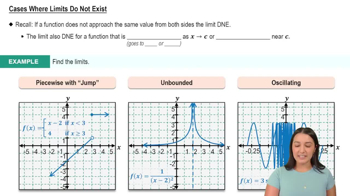
Cases Where Limits Do Not Exist

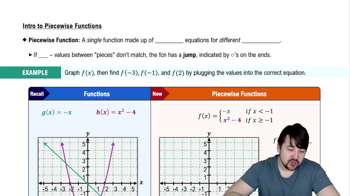
Piecewise Functions

Piecewise functions are defined by different expressions based on the input value. In the context of the given question, the function is defined differently for values less than or equal to 1 and for values greater than 1. Understanding how to evaluate and differentiate piecewise functions is crucial, as the behavior of the function can change at the boundaries, affecting the calculation of derivatives at those points.
Video consigliato:
Percorso guidato
05:36
Piecewise Functions
Pratica correlata