Ch. 3 - Derivatives
Briggs - Calculus: Early Transcendentals 3rd Edition
Briggs3rd EditionCalculus: Early TranscendentalsISBN: 9780136847243Non è quello che usi tu?Cambia libro di testo
Capitolo 3, Problema 3.6.56c

{Use of Tech} Power and energy Power and energy are often used interchangeably, but they are quite different. Energy is what makes matter move or heat up. It is measured in units of joules or Calories, where 1 Cal=4184 J. One hour of walking consumes roughly 10⁶J, or 240 Cal. On the other hand, power is the rate at which energy is used, which is measured in watts, where 1 W=1 J/s. Other useful units of power are kilowatts (1 kW=10³ W) and megawatts (1 MW=10⁶ W). If energy is used at a rate of 1 kW for one hour, the total amount of energy used is 1 kilowatt-hour (1 kWh=3.6×10⁶ J) Suppose the cumulative energy used in a large building over a 24-hr period is given by E(t)=100t+4t²−t³ / 9kWh where t=0 corresponds to midnight.
c. Graph the power function and interpret the graph. What are the units of power in this case?

Guida verificata passo dopo passo
1
To find the power function, we need to determine the rate of change of energy with respect to time. This involves taking the derivative of the energy function E(t) with respect to t.
The given energy function is E(t) = 100t + 4t² - t³ / 9. To find the power function P(t), compute the derivative: P(t) = dE/dt.
Differentiate each term of E(t) with respect to t: The derivative of 100t is 100, the derivative of 4t² is 8t, and the derivative of -t³/9 is -3t²/9 or -t²/3.
Combine these derivatives to get the power function: P(t) = 100 + 8t - t²/3.
Graph the power function P(t) = 100 + 8t - t²/3. The units of power in this case are kilowatts (kW), as the energy function E(t) is given in kilowatt-hours (kWh) and time t is in hours.

Risposta video verificata per un problema simile:

Questa soluzione video è stata consigliata dai nostri tutor come utile per risolvere questo problema.
Durata del video:
3m

Concetti chiave

Ecco i concetti essenziali che devi comprendere per rispondere correttamente alla domanda.

Energy vs. Power

Energy is the capacity to do work or produce heat, measured in joules (J) or calories (Cal). Power, on the other hand, is the rate at which energy is consumed or produced, measured in watts (W), where 1 W equals 1 J/s. Understanding the distinction between these two concepts is crucial for analyzing how energy is utilized over time.
Video consigliato:
04:02
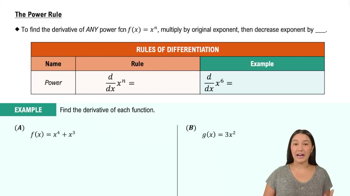
The Power Rule

Cumulative Energy Function

The cumulative energy function E(t) = 100t + 4t² - t³ represents the total energy consumed over time, where t is measured in hours. This function allows us to calculate the energy used at any given time and is essential for determining the power function by differentiating E(t) with respect to time.
Video consigliato:
Percorso guidato
06:21
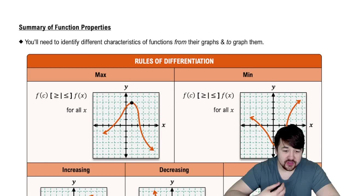
Properties of Functions

Graphing Power Function

To graph the power function, we first derive it from the cumulative energy function, which gives us the rate of energy consumption at any time t. The resulting power function will be plotted against time, allowing us to visualize how power usage changes throughout the day. The units of power in this context will be in kilowatts (kW), reflecting the energy consumption rate.
Video consigliato:
Percorso guidato
5:53
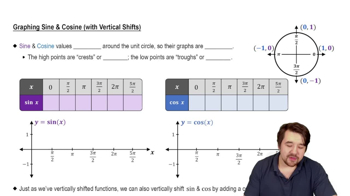
Graph of Sine and Cosine Function
Pratica correlata
Domanda del libro di testo

Derivatives of inverse functions from a table Use the following tables to determine the indicated derivatives or state that the derivative cannot be determined. <IMAGE>

c. (f^-1)'(1)

167
views

Domanda del libro di testo

{Use of Tech} Spring runoff The flow of a small stream is monitored for 90 days between May 1 and August 1. The total water that flows past a gauging station is given by v(t) = <matrix 2x2> where V is measured in cubic feet and t is measured in days, with t=0 corresponding to May 1.

c. Describe the flow of the stream over the 3-month period. Specifically, when is the flow rate a maximum?

218
views
Domanda del libro di testo

Another way to approximate derivatives is to use the centered difference quotient: f' (a) ≈ f(a+h) - f(a- h) / 2h. Again, consider f(x) = √x.

c. Explain why it is not necessary to use negative values of h in the table of part (b).

361
views
Domanda del libro di testo

62–65. {Use of Tech} Graphing f and f'

c. Verify that the zeros of f' correspond to points at which f has a horizontal tangent line.

f(x)=(sec^−1 x)/x on [1,∞)

219
views
Domanda del libro di testo

Derivatives of sin^n x Calculate the following derivatives using the Product Rule.

c. d/dx (sin⁴ x)

299
views
Domanda del libro di testo

Suppose a stone is thrown vertically upward from the edge of a cliff on Earth with an initial velocity of 19.6 m/s from a height of 24.5 m above the ground. The height (in meters) of the stone above the ground t seconds after it is thrown is s(t) = -4.9t²+19.6t+24.5.

c. What is the height of the stone at the highest point?

183
views