
Ch. 3 - Derivatives
Briggs - Calculus: Early Transcendentals 3rd Edition
Briggs3rd EditionCalculus: Early TranscendentalsISBN: 9780136847243Non è quello che usi tu?Cambia libro di testo
Capitolo 3, Problema 3.10.64c

62–65. {Use of Tech} Graphing f and f'
c. Verify that the zeros of f' correspond to points at which f has a horizontal tangent line.
f(x)=(sec^−1 x)/x on [1,∞)

Guida verificata passo dopo passo
1
Step 1: Understand the function f(x) = \(\frac{\sec^{-1}\)(x)}{x} and its domain [1, \(\infty\)). The function involves the inverse secant function, which is defined for x \(\geq\) 1.
Step 2: Find the derivative f'(x) using the quotient rule. The quotient rule states that if you have a function h(x) = \(\frac{u(x)}{v(x)}\), then h'(x) = \(\frac{u'(x)v(x) - u(x)v'(x)}{(v(x))^2}\). Here, u(x) = \(\sec\)^{-1}(x) and v(x) = x.
Step 3: Calculate the derivatives u'(x) and v'(x). For u(x) = \(\sec\)^{-1}(x), use the derivative formula \(\frac{d}{dx}\)[\(\sec\)^{-1}(x)] = \(\frac{1}{|x|\sqrt{x^2 - 1}\)}. For v(x) = x, the derivative v'(x) = 1.
Step 4: Substitute u'(x), u(x), v'(x), and v(x) into the quotient rule formula to find f'(x). Simplify the expression to get the derivative in a manageable form.
Step 5: Set f'(x) = 0 to find the zeros of the derivative. These zeros correspond to the x-values where the original function f(x) has horizontal tangent lines. Verify these points by checking the graph of f(x) and f'(x) using technology.

Risposta video verificata per un problema simile:

Questa soluzione video è stata consigliata dai nostri tutor come utile per risolvere questo problema.
Durata del video:
8m

Concetti chiave

Ecco i concetti essenziali che devi comprendere per rispondere correttamente alla domanda.

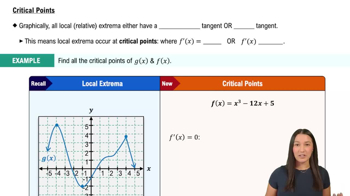
Derivative and Critical Points

The derivative of a function, denoted as f'(x), represents the rate of change of the function f(x) at any point x. Critical points occur where the derivative is zero or undefined, indicating potential locations for horizontal tangent lines. Understanding how to find and interpret these points is essential for analyzing the behavior of the function.
Video consigliato:
04:50
Critical Points

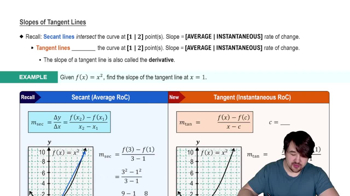
Horizontal Tangent Lines

A horizontal tangent line occurs at points where the derivative of a function equals zero, meaning the slope of the tangent line is flat. This indicates that the function is neither increasing nor decreasing at that point, which is crucial for identifying local maxima, minima, or points of inflection. Verifying these points involves checking where f'(x) = 0.
Video consigliato:
Percorso guidato
05:13
Slopes of Tangent Lines

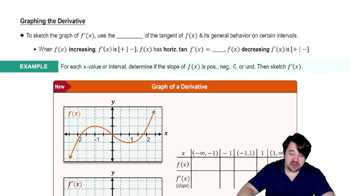
Graphing Functions and Their Derivatives

Graphing a function f(x) alongside its derivative f'(x) provides visual insight into the function's behavior. The zeros of f' correspond to the x-values where f has horizontal tangents, allowing for a clear understanding of how the function behaves at those points. This graphical representation aids in confirming the relationship between a function and its derivative.
Video consigliato:
Percorso guidato
06:15
Graphing The Derivative
Pratica correlata
Domanda del libro di testo

{Use of Tech} Power and energy Power and energy are often used interchangeably, but they are quite different. Energy is what makes matter move or heat up. It is measured in units of joules or Calories, where 1 Cal=4184 J. One hour of walking consumes roughly 10⁶J, or 240 Cal. On the other hand, power is the rate at which energy is used, which is measured in watts, where 1 W=1 J/s. Other useful units of power are kilowatts (1 kW=10³ W) and megawatts (1 MW=10⁶ W). If energy is used at a rate of 1 kW for one hour, the total amount of energy used is 1 kilowatt-hour (1 kWh=3.6×10⁶ J) Suppose the cumulative energy used in a large building over a 24-hr period is given by E(t)=100t+4t²−t³ / 9kWh where t=0 corresponds to midnight.

c. Graph the power function and interpret the graph. What are the units of power in this case?

215
views
Domanda del libro di testo

Derivatives of inverse functions from a table Use the following tables to determine the indicated derivatives or state that the derivative cannot be determined. <IMAGE>

c. (f^-1)'(1)

167
views
Domanda del libro di testo

Another way to approximate derivatives is to use the centered difference quotient: f' (a) ≈ f(a+h) - f(a- h) / 2h. Again, consider f(x) = √x.

c. Explain why it is not necessary to use negative values of h in the table of part (b).

361
views
Domanda del libro di testo

Derivatives of sin^n x Calculate the following derivatives using the Product Rule.

c. d/dx (sin⁴ x)

299
views
Domanda del libro di testo

Computing the derivative of f(x) = e^-x

c. Use parts (a) and (b) to find the derivative of f(x) = e^-x.

255
views
Domanda del libro di testo

Suppose a stone is thrown vertically upward from the edge of a cliff on Earth with an initial velocity of 19.6 m/s from a height of 24.5 m above the ground. The height (in meters) of the stone above the ground t seconds after it is thrown is s(t) = -4.9t²+19.6t+24.5.

c. What is the height of the stone at the highest point?

183
views