Ch. 3 - Derivatives
Briggs - Calculus: Early Transcendentals 3rd Edition
Briggs3rd EditionCalculus: Early TranscendentalsISBN: 9780136847243Non è quello che usi tu?Cambia libro di testo
Capitolo 3, Problema 3.2.76

Vertical tangent lines If a function f is continuous at a and lim x→a| f′(x)|=∞, then the curve y=f(x) has a vertical tangent line at a, and the equation of the tangent line is x=a. If a is an endpoint of a domain, then the appropriate one-sided derivative (Exercises 71–72) is used. Use this information to answer the following questions.
Graph the following curves and determine the location of any vertical tangent lines.
a. x²+y² = 9

Guida verificata passo dopo passo
1
First, recognize that the given equation x² + y² = 9 represents a circle centered at the origin with a radius of 3.
To find vertical tangent lines, we need to express y as a function of x. Rearrange the equation to solve for y: y = ±√(9 - x²).
Differentiate y with respect to x to find the derivative y'. For y = √(9 - x²), use the chain rule: y' = (1/2)(9 - x²)^(-1/2) * (-2x). Simplify to get y' = -x / √(9 - x²).
Consider the limit of |y'| as x approaches the endpoints of the domain of y. The domain of y is -3 ≤ x ≤ 3. Check the behavior of y' as x approaches ±3.
As x approaches ±3, the denominator √(9 - x²) approaches 0, causing |y'| to approach infinity. This indicates vertical tangent lines at the points where x = ±3.

Risposta video verificata per un problema simile:

Questa soluzione video è stata consigliata dai nostri tutor come utile per risolvere questo problema.
Durata del video:
8m

Concetti chiave

Ecco i concetti essenziali che devi comprendere per rispondere correttamente alla domanda.

Vertical Tangent Lines

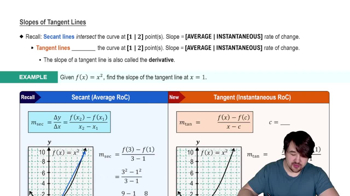
A vertical tangent line occurs at a point on a curve where the slope of the tangent approaches infinity. This typically indicates that the function is increasing or decreasing without bound at that point. In calculus, this is identified when the derivative of the function becomes undefined or approaches infinity, suggesting a steep incline or decline.
Video consigliato:
Percorso guidato
05:13
Slopes of Tangent Lines

Implicit Differentiation

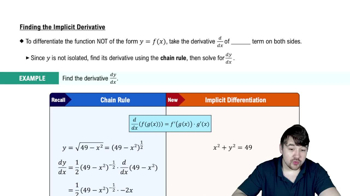
Implicit differentiation is a technique used to find the derivative of a function defined implicitly by an equation, rather than explicitly as y = f(x). This method involves differentiating both sides of the equation with respect to x and solving for dy/dx. It is particularly useful for curves defined by equations like x² + y² = 9, where y cannot be easily isolated.
Video consigliato:
Percorso guidato
05:14
Finding The Implicit Derivative

Endpoints and One-Sided Derivatives

Endpoints of a domain refer to the boundaries of the interval in which a function is defined. At these points, the behavior of the function may differ from that in the interior of the interval. One-sided derivatives are used to analyze the slope of the function from one direction (left or right) at these endpoints, which is crucial for determining the existence of vertical tangents in such cases.
Video consigliato:
05:50
One-Sided Limits