Ch. 4 - Applications of the Derivative
Briggs - Calculus: Early Transcendentals 3rd Edition
Briggs3rd EditionCalculus: Early TranscendentalsISBN: 9780136847243Non è quello che usi tu?Cambia libro di testo
Capitolo 4, Problema 4.7.46

17–83. Limits Evaluate the following limits. Use l’Hôpital’s Rule when it is convenient and applicable.


lim_x→∞ (ln(3x + 5eˣ)) / (ln(7x + 3e²ˣ)

Guida verificata passo dopo passo
1
Identify the form of the limit as x approaches infinity. Both the numerator and the denominator are logarithmic functions, which tend to infinity as x approaches infinity. This suggests an indeterminate form of type ∞/∞, making l'Hôpital's Rule applicable.
Apply l'Hôpital's Rule, which states that for limits of the form ∞/∞, the limit of the ratio of the derivatives of the numerator and the denominator can be taken. Differentiate the numerator: d/dx[ln(3x + 5e^x)] = (3 + 5e^x) / (3x + 5e^x).
Differentiate the denominator: d/dx[ln(7x + 3e^(2x))] = (7 + 6xe^(2x)) / (7x + 3e^(2x)).
Substitute the derivatives back into the limit expression: lim_x→∞ [(3 + 5e^x) / (3x + 5e^x)] / [(7 + 6xe^(2x)) / (7x + 3e^(2x))].
Simplify the expression by dividing the numerators and denominators, and evaluate the limit as x approaches infinity. Consider the dominant terms in the expressions to determine the behavior of the limit.

Risposta video verificata per un problema simile:

Questa soluzione video è stata consigliata dai nostri tutor come utile per risolvere questo problema.
Durata del video:
8m

Concetti chiave

Ecco i concetti essenziali che devi comprendere per rispondere correttamente alla domanda.

Limits

Limits are fundamental concepts in calculus that describe the behavior of a function as its input approaches a certain value. They help in understanding the function's behavior at points where it may not be explicitly defined, such as at infinity or at points of discontinuity. Evaluating limits is crucial for determining the continuity and differentiability of functions.
Video consigliato:
05:50
One-Sided Limits

L'Hôpital's Rule

L'Hôpital's Rule is a method used to evaluate limits that result in indeterminate forms, such as 0/0 or ∞/∞. It states that if the limit of the ratio of two functions yields an indeterminate form, the limit of their derivatives can be taken instead. This rule simplifies the process of finding limits, especially when dealing with logarithmic or exponential functions.
Video consigliato:
5:50
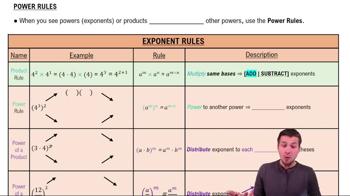
Power Rules

Natural Logarithm

The natural logarithm, denoted as ln(x), is the logarithm to the base e, where e is approximately 2.71828. It is a key function in calculus, particularly in growth and decay problems, and is often used in conjunction with limits and derivatives. Understanding the properties of logarithms, such as their behavior at infinity, is essential for evaluating limits involving logarithmic expressions.
Video consigliato:
05:18
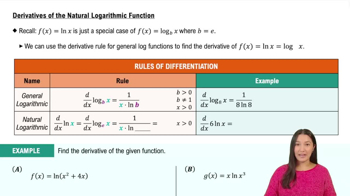
Derivative of the Natural Logarithmic Function