Ch. 4 - Applications of the Derivative
Briggs - Calculus: Early Transcendentals 3rd Edition
Briggs3rd EditionCalculus: Early TranscendentalsISBN: 9780136847243Non è quello che usi tu?Cambia libro di testo
Capitolo 4, Problema 4.9.91

Velocity to position Given the following velocity functions of an object moving along a line, find the position function with the given initial position.


v(t) = 2t + 4; s(0) = 0

Guida verificata passo dopo passo
1
Step 1: Recall that the position function s(t) is the integral of the velocity function v(t). To find s(t), we need to compute the indefinite integral of v(t) = 2t + 4.
Step 2: Set up the integral: \( s(t) = \int v(t) \, dt = \int (2t + 4) \, dt \). Break the integral into two parts: \( \int 2t \, dt \) and \( \int 4 \, dt \).
Step 3: Compute the integral of each term. For \( \int 2t \, dt \), use the power rule \( \int t^n \, dt = \frac{t^{n+1}}{n+1} \). For \( \int 4 \, dt \), treat 4 as a constant and integrate to get \( 4t \).
Step 4: Combine the results of the integration: \( s(t) = t^2 + 4t + C \), where C is the constant of integration.
Step 5: Use the initial condition \( s(0) = 0 \) to solve for C. Substitute \( t = 0 \) into \( s(t) = t^2 + 4t + C \), which gives \( 0 = 0^2 + 4(0) + C \). Solve for C to find its value, and substitute it back into the position function.

Risposta video verificata per un problema simile:

Questa soluzione video è stata consigliata dai nostri tutor come utile per risolvere questo problema.
Durata del video:
2m

Concetti chiave

Ecco i concetti essenziali che devi comprendere per rispondere correttamente alla domanda.

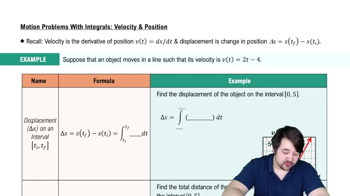
Velocity and Position Functions

Velocity is the rate of change of position with respect to time, represented mathematically as the derivative of the position function. In this context, the velocity function v(t) = 2t + 4 describes how the object's speed changes over time. To find the position function, we need to integrate the velocity function.
Video consigliato:
Percorso guidato
10:17
Using The Velocity Function

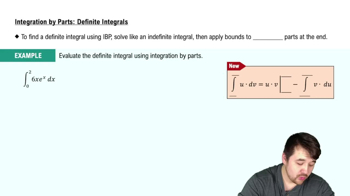
Integration

Integration is the process of finding the antiderivative of a function, which allows us to determine the original function from its rate of change. In this case, integrating the velocity function v(t) will yield the position function s(t). The integration process will also include a constant of integration, which can be determined using the initial position condition.
Video consigliato:
Percorso guidato
06:18
Integration by Parts for Definite Integrals

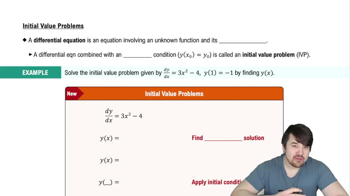
Initial Conditions

Initial conditions are specific values that help determine the constants in a function after integration. In this problem, the initial position s(0) = 0 provides a boundary condition that allows us to solve for the constant of integration after finding the position function. This ensures that the solution accurately reflects the object's position at the start of the observation.
Video consigliato:
Percorso guidato
05:03
Initial Value Problems