
Ch. 4 - Applications of the Derivative
Briggs - Calculus: Early Transcendentals 3rd Edition
Briggs3rd EditionCalculus: Early TranscendentalsISBN: 9780136847243Non è quello che usi tu?Cambia libro di testo
Capitolo 4, Problema 4.9.23

23–68. Indefinite integrals Determine the following indefinite integrals. Check your work by differentiation.


∫ (3x⁵ - 5x⁹) dx

Guida verificata passo dopo passo
1
Step 1: Recall the power rule for integration, which states that for any term xⁿ, the integral is ∫xⁿ dx = (xⁿ⁺¹)/(n+1) + C, where C is the constant of integration.
Step 2: Apply the power rule to each term in the integrand separately. For the term 3x⁵, integrate it as (3 * x⁶)/6. For the term -5x⁹, integrate it as (-5 * x¹⁰)/10.
Step 3: Combine the results from Step 2 into a single expression: (3x⁶)/6 - (5x¹⁰)/10 + C.
Step 4: Simplify the coefficients in the expression. For example, (3x⁶)/6 simplifies to x⁶/2, and (-5x¹⁰)/10 simplifies to -x¹⁰/2.
Step 5: Write the final simplified indefinite integral: x⁶/2 - x¹⁰/2 + C. To check your work, differentiate this expression and verify that it matches the original integrand, 3x⁵ - 5x⁹.

Risposta video verificata per un problema simile:

Questa soluzione video è stata consigliata dai nostri tutor come utile per risolvere questo problema.
Durata del video:
2m

Concetti chiave

Ecco i concetti essenziali che devi comprendere per rispondere correttamente alla domanda.

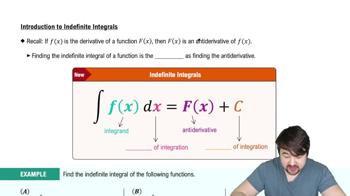
Indefinite Integrals

Indefinite integrals represent a family of functions whose derivative is the integrand. They are expressed without limits and include a constant of integration, typically denoted as 'C'. The process of finding an indefinite integral is essentially the reverse of differentiation, allowing us to recover original functions from their rates of change.
Video consigliato:
Percorso guidato
05:04
Introduction to Indefinite Integrals

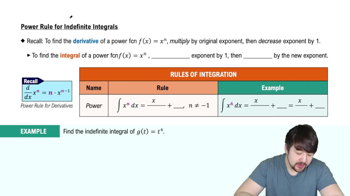
Power Rule for Integration

The power rule for integration is a fundamental technique used to integrate polynomial functions. It states that the integral of x raised to the power n (where n ≠ -1) is (x^(n+1))/(n+1) + C. This rule simplifies the process of finding indefinite integrals of terms like 3x⁵ and -5x⁹ by increasing the exponent and dividing by the new exponent.
Video consigliato:
Percorso guidato
04:04
Power Rule for Indefinite Integrals

Verification by Differentiation

Verification by differentiation involves taking the derivative of the result obtained from an indefinite integral to ensure it matches the original integrand. This step is crucial for confirming the correctness of the integration process, as it provides a check that the integration was performed accurately and that no errors were made in the calculations.
Video consigliato:
Percorso guidato
05:53
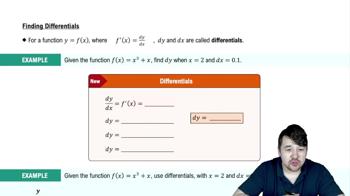
Finding Differentials
Pratica correlata
Domanda del libro di testo

{Use of Tech} Special curves The following classical curves have been studied by generations of mathematicians. Use analytical methods (including implicit differentiation) and a graphing utility to graph the curves. Include as much detail as possible.


y = 8/(x² + 4) (Witch of Agnesi)

214
views
Domanda del libro di testo

17–83. Limits Evaluate the following limits. Use l’Hôpital’s Rule when it is convenient and applicable.


lim_x→0 x csc x

215
views
Domanda del libro di testo

23–68. Indefinite integrals Determine the following indefinite integrals. Check your work by differentiation.


∫ (6/√(4 - 4x²))dx

57
views
Domanda del libro di testo

{Use of Tech} Finding all roots Use Newton’s method to find all the roots of the following functions. Use preliminary analysis and graphing to determine good initial approximations.


f(x) = x/6 - sec x on [0,8]

225
views
Domanda del libro di testo

Light transmission A window consists of a rectangular pane of clear glass surmounted by a semicircular pane of tinted glass. The clear glass transmits twice as much light per unit of surface area as the tinted glass. Of all such windows with a fixed perimeter P, what are the dimensions of the window that transmits the most light?

227
views
Domanda del libro di testo

Mean Value Theorem and graphs Find all points on the interval (1,3) at which the slope of the tangent line equals the average rate of change of f on [1,3]. Reconcile your results with the Mean Value Theorem. <IMAGE>

281
views