Ch. 4 - Applications of the Derivative
Briggs - Calculus: Early Transcendentals 3rd Edition
Briggs3rd EditionCalculus: Early TranscendentalsISBN: 9780136847243Non è quello che usi tu?Cambia libro di testo
Capitolo 4, Problema 4.2.40

Mean Value Theorem and graphs Find all points on the interval (1,3) at which the slope of the tangent line equals the average rate of change of f on [1,3]. Reconcile your results with the Mean Value Theorem. <IMAGE>

Guida verificata passo dopo passo
1
First, understand the Mean Value Theorem (MVT): It states that for a continuous function f on the closed interval [a, b] that is differentiable on the open interval (a, b), there exists at least one point c in (a, b) such that the derivative at c, f'(c), is equal to the average rate of change of the function over [a, b].
Calculate the average rate of change of the function f on the interval [1, 3]. This is given by the formula: (f(3) - f(1)) / (3 - 1).
Find the derivative of the function, f'(x), which represents the slope of the tangent line at any point x.
Set the derivative f'(x) equal to the average rate of change calculated in step 2. Solve this equation to find the value(s) of x in the interval (1, 3) where the slope of the tangent line equals the average rate of change.
Verify that the solution(s) found in step 4 satisfy the conditions of the Mean Value Theorem: the function must be continuous on [1, 3] and differentiable on (1, 3). If these conditions are met, the solution(s) are valid according to the theorem.

Risposta video verificata per un problema simile:

Questa soluzione video è stata consigliata dai nostri tutor come utile per risolvere questo problema.
Durata del video:
2m

Concetti chiave

Ecco i concetti essenziali che devi comprendere per rispondere correttamente alla domanda.

Mean Value Theorem

The Mean Value Theorem (MVT) states that if a function is continuous on a closed interval [a, b] and differentiable on the open interval (a, b), then there exists at least one point c in (a, b) where the derivative of the function at c equals the average rate of change of the function over [a, b]. This theorem is fundamental in connecting the behavior of a function to its derivative.
Video consigliato:
Percorso guidato
06:11
Fundamental Theorem of Calculus Part 1

Average Rate of Change

The average rate of change of a function f over an interval [a, b] is calculated as (f(b) - f(a)) / (b - a). This value represents the slope of the secant line connecting the points (a, f(a)) and (b, f(b)). Understanding this concept is crucial for applying the Mean Value Theorem, as it provides the value that the derivative must equal at some point within the interval.
Video consigliato:
Percorso guidato
06:37
Average Value of a Function

Tangent Line and Derivative

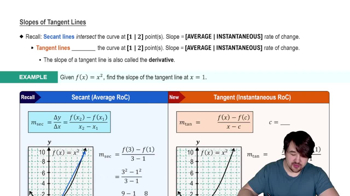
The slope of the tangent line to a function at a given point is represented by the derivative of the function at that point. This slope indicates the instantaneous rate of change of the function. In the context of the Mean Value Theorem, finding points where the tangent line's slope equals the average rate of change is essential for identifying the specific points c where the theorem holds true.
Video consigliato:
Percorso guidato
05:13
Slopes of Tangent Lines