
Domanda del libro di testo
Differentials Consider the following functions and express the relationship between a small change in x and the corresponding change in y in the form dy = f'(x)dx.
f(x) = 2x + 1
251
views

 Guida verificata passo dopo passo
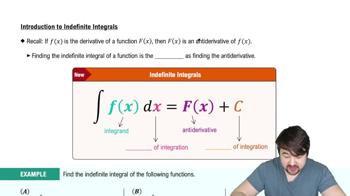
 05:04
05:04
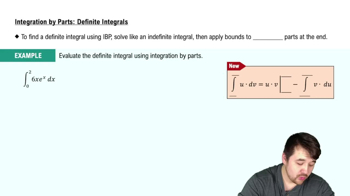 06:18
06:18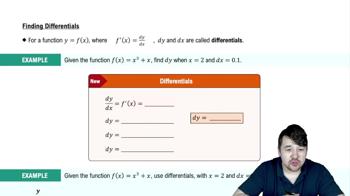 05:53
05:53Differentials Consider the following functions and express the relationship between a small change in x and the corresponding change in y in the form dy = f'(x)dx.
f(x) = 2x + 1
23–68. Indefinite integrals Determine the following indefinite integrals. Check your work by differentiation.
∫ ((e²ʷ - 5eʷ + 4)/(eʷ - 1))dw
105–106. {Use of Tech} Races The velocity function and initial position of Runners A and B are given. Analyze the race that results by graphing the position functions of the runners and finding the time and positions (if any) at which they first pass each other.
A : v(t) = sin t; s(0) = 0 B. V(t) = cos t; S(0) = 0
Increasing and decreasing functions. Find the intervals on which f is increasing and the intervals on which it is decreasing.
f(x) = √(9 - x²) + sin⁻¹ (x/3)
Second Derivative Test Locate the critical points of the following functions. Then use the Second Derivative Test to determine (if possible) whether they correspond to local maxima or local minima.
f(x) = 2x² ln x - 11x²
Increasing and decreasing functions. Find the intervals on which f is increasing and the intervals on which it is decreasing.
f(x) = tan⁻¹ (x/(x²+2))