Ch. 4 - Applications of the Derivative
Briggs - Calculus: Early Transcendentals 3rd Edition
Briggs3rd EditionCalculus: Early TranscendentalsISBN: 9780136847243Non è quello che usi tu?Cambia libro di testo
Capitolo 4, Problema 4.3.37

Increasing and decreasing functions. Find the intervals on which f is increasing and the intervals on which it is decreasing.


f(x) = √(9 - x²) + sin⁻¹ (x/3)

Guida verificata passo dopo passo
1
First, find the derivative of the function f(x) = √(9 - x²) + sin⁻¹(x/3). Use the chain rule for the square root term and the derivative of the inverse sine function for the second term.
The derivative of √(9 - x²) is (1/2)(9 - x²)^(-1/2) * (-2x) = -x / √(9 - x²).
The derivative of sin⁻¹(x/3) is 1 / √(1 - (x/3)²) * (1/3) = 1 / (3√(1 - x²/9)).
Combine these derivatives to find f'(x): f'(x) = -x / √(9 - x²) + 1 / (3√(1 - x²/9)).
Determine where f'(x) is positive (indicating f is increasing) and where it is negative (indicating f is decreasing) by solving the inequality f'(x) > 0 and f'(x) < 0, respectively. Consider the domain restrictions from the square root and inverse sine functions.

Risposta video verificata per un problema simile:

Questa soluzione video è stata consigliata dai nostri tutor come utile per risolvere questo problema.
Durata del video:
7m

Concetti chiave

Ecco i concetti essenziali che devi comprendere per rispondere correttamente alla domanda.

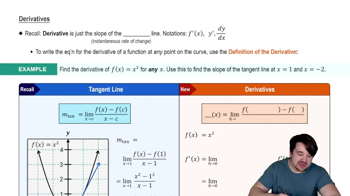
Derivative

The derivative of a function measures the rate at which the function's value changes as its input changes. It is a fundamental tool in calculus for determining the slope of the tangent line to the curve at any point. By analyzing the sign of the derivative, we can identify intervals where the function is increasing (derivative > 0) or decreasing (derivative < 0).
Video consigliato:

Critical Points

Critical points occur where the derivative of a function is either zero or undefined. These points are essential for determining the behavior of the function, as they can indicate local maxima, minima, or points of inflection. To find intervals of increase or decrease, we evaluate the derivative at these critical points and test the sign of the derivative in the intervals they create.
Video consigliato:
04:50
Critical Points

Increasing and Decreasing Intervals

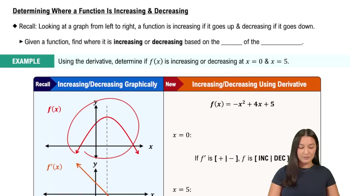
An increasing interval is a range of x-values where the function's output rises as x increases, while a decreasing interval is where the output falls. To find these intervals, we analyze the sign of the derivative across the critical points. If the derivative is positive in an interval, the function is increasing; if negative, it is decreasing.
Video consigliato:
07:32
Determining Where a Function is Increasing & Decreasing
Pratica correlata
Domanda del libro di testo

23–68. Indefinite integrals Determine the following indefinite integrals. Check your work by differentiation.


∫ (5s + 3)² ds

74
views

Domanda del libro di testo

Differentials Consider the following functions and express the relationship between a small change in x and the corresponding change in y in the form dy = f'(x)dx.


f(x) = 2x + 1

251
views
Domanda del libro di testo

23–68. Indefinite integrals Determine the following indefinite integrals. Check your work by differentiation.


∫ ((e²ʷ - 5eʷ + 4)/(eʷ - 1))dw

54
views
Domanda del libro di testo

{Use of Tech} A pursuit curve A man stands 1 mi east of a crossroads. At noon, a dog starts walking north from the crossroads at 1 mi/hr (see figure). At the same instant, the man starts walking and at all times walks directly toward the dog at s > 1 mi/hr . The path in the xy-plane followed by the man as he pursues the dog is given by the function y = ƒ(x) = s/2 ((x(ˢ⁺¹)/ˢ) /(s+1) - (x(ˢ⁺¹)/ˢ / s-1)) + s/ s² - 1


Select various values of s > 1 and graph this pursuit curve. Comment on the changes in the curve as s increases. <IMAGE>


225
views
Domanda del libro di testo

Second Derivative Test Locate the critical points of the following functions. Then use the Second Derivative Test to determine (if possible) whether they correspond to local maxima or local minima.


f(x) = 2x² ln x - 11x²

210
views
Domanda del libro di testo

Increasing and decreasing functions. Find the intervals on which f is increasing and the intervals on which it is decreasing.


f(x) = tan⁻¹ (x/(x²+2))

221
views