Ch. 4 - Applications of the Derivative
Briggs - Calculus: Early Transcendentals 3rd Edition
Briggs3rd EditionCalculus: Early TranscendentalsISBN: 9780136847243Non è quello che usi tu?Cambia libro di testo
Capitolo 4, Problema 74

Concavity Determine the intervals on which the following functions are concave up or concave down. Identify any inflection points.


h(t) = 2 + cos 2t on [0,π]

Guida verificata passo dopo passo
1
To determine the concavity of the function h(t) = 2 + cos(2t), we first need to find its second derivative. Start by finding the first derivative h'(t). The derivative of cos(2t) is -2sin(2t) using the chain rule.
Next, find the second derivative h''(t). Differentiate h'(t) = -2sin(2t) to get h''(t) = -4cos(2t) using the chain rule again.
To find intervals of concavity, set the second derivative equal to zero and solve for t: -4cos(2t) = 0. This simplifies to cos(2t) = 0. Solve for t in the interval [0, π].
The solutions to cos(2t) = 0 are t = π/4 and t = 3π/4 within the interval [0, π]. These are potential inflection points where the concavity might change.
Test the intervals (0, π/4), (π/4, 3π/4), and (3π/4, π) by choosing test points in each interval and evaluating the sign of h''(t). If h''(t) > 0, the function is concave up; if h''(t) < 0, the function is concave down. Identify the intervals of concavity and any inflection points based on these tests.

Risposta video verificata per un problema simile:

Questa soluzione video è stata consigliata dai nostri tutor come utile per risolvere questo problema.
Durata del video:
6m

Concetti chiave

Ecco i concetti essenziali che devi comprendere per rispondere correttamente alla domanda.

Concavity

Concavity refers to the direction in which a function curves. A function is concave up on an interval if its second derivative is positive, indicating that the slope of the tangent line is increasing. Conversely, it is concave down if the second derivative is negative, meaning the slope is decreasing. Understanding concavity helps in analyzing the behavior of functions and identifying points of inflection.
Video consigliato:
05:59
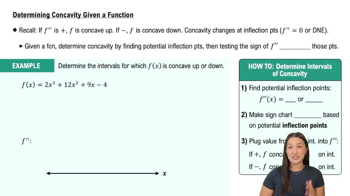
Determining Concavity Given a Function

Second Derivative Test

The second derivative test is a method used to determine the concavity of a function. By calculating the second derivative of a function, we can assess whether it is positive or negative over specific intervals. If the second derivative changes sign, it indicates a point of inflection, where the function changes from concave up to concave down or vice versa. This test is essential for identifying concavity and inflection points.
Video consigliato:
06:02
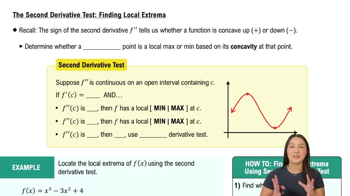
The Second Derivative Test: Finding Local Extrema

Inflection Points

Inflection points are points on a curve where the concavity changes. At these points, the second derivative of the function is either zero or undefined. Identifying inflection points is crucial for understanding the overall shape of the graph and how it behaves as it transitions between concave up and concave down. These points can provide valuable insights into the function's behavior and are often of interest in optimization problems.
Video consigliato:
04:50
Critical Points
Pratica correlata
Domanda del libro di testo

Concavity Determine the intervals on which the following functions are concave up or concave down. Identify any inflection points.


f(x) = ³√(x - 4)

431
views

Domanda del libro di testo

Concavity Determine the intervals on which the following functions are concave up or concave down. Identify any inflection points.


g(t) = 3t⁵ - 30t⁴ + 80t³ + 100

213
views
Domanda del libro di testo

Concavity Determine the intervals on which the following functions are concave up or concave down. Identify any inflection points.


f(x) = x⁴eˣ + x

243
views
Domanda del libro di testo

Another pen problem A rancher is building a horse pen on the corner of her property using 1000 ft of fencing. Because of the unusual shape of her property, the pen must be built in the shape of a trapezoid (see figure). <IMAGE>

b. Suppose there is already a fence along the side of the property opposite the side of length y. Find the lengths of the sides that maximize the area of the pen, using 1000 ft of fencing.

281
views
Domanda del libro di testo

Concavity Determine the intervals on which the following functions are concave up or concave down. Identify any inflection points.


f(x) = 2x⁴ + 8x³ + 12x² - x - 2

281
views
Domanda del libro di testo

The arbelos An arbelos is the region enclosed by three mutually tangent semicircles; it is the region inside the larger semicircle and outside the two smaller semicircles (see figure). <IMAGE>

b. Show that the area of the arbelos is the area of a circle whose diameter is the distance BD in the figure.

292
views