Ch. 4 - Applications of the Derivative
Briggs - Calculus: Early Transcendentals 3rd Edition
Briggs3rd EditionCalculus: Early TranscendentalsISBN: 9780136847243Non è quello che usi tu?Cambia libro di testo
Capitolo 4, Problema 70

Concavity Determine the intervals on which the following functions are concave up or concave down. Identify any inflection points.


f(x) = ³√(x - 4)

Guida verificata passo dopo passo
1
First, find the first derivative of the function f(x) = ³√(x - 4). This involves using the chain rule. The derivative of ³√u with respect to u is (1/3)u^(-2/3). Therefore, f'(x) = (1/3)(x - 4)^(-2/3).
Next, find the second derivative, f''(x), to determine concavity. Differentiate f'(x) = (1/3)(x - 4)^(-2/3) again using the chain rule. The derivative of u^(-2/3) is (-2/3)u^(-5/3), so f''(x) = (-2/9)(x - 4)^(-5/3).
Determine the intervals of concavity by analyzing the sign of f''(x). The function is concave up where f''(x) > 0 and concave down where f''(x) < 0. Since f''(x) = (-2/9)(x - 4)^(-5/3), it is important to note that the sign of f''(x) depends on the sign of (x - 4).
Identify any inflection points by finding where f''(x) changes sign. This occurs when x = 4, as the expression (x - 4) changes from negative to positive or vice versa.
Summarize the findings: The function is concave down for x < 4 and concave up for x > 4. The point x = 4 is an inflection point where the concavity changes.

Risposta video verificata per un problema simile:

Questa soluzione video è stata consigliata dai nostri tutor come utile per risolvere questo problema.
Durata del video:
8m

Concetti chiave

Ecco i concetti essenziali che devi comprendere per rispondere correttamente alla domanda.

Concavity

Concavity refers to the direction in which a function curves. A function is concave up on an interval if its second derivative is positive, indicating that the slope of the tangent line is increasing. Conversely, it is concave down if the second derivative is negative, meaning the slope is decreasing. Understanding concavity helps in analyzing the behavior of functions and identifying intervals of increase or decrease.
Video consigliato:
05:59
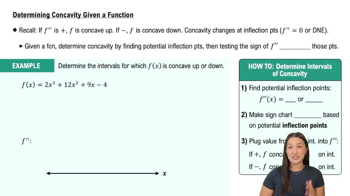
Determining Concavity Given a Function

Second Derivative Test

The second derivative test is a method used to determine the concavity of a function and locate inflection points. By calculating the second derivative of a function, we can assess where it changes sign, indicating a transition between concave up and concave down. Inflection points occur where the second derivative is zero or undefined, and the concavity changes, providing critical insights into the function's graph.
Video consigliato:
06:02
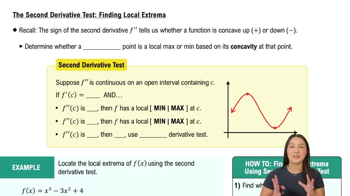
The Second Derivative Test: Finding Local Extrema

Inflection Points

Inflection points are specific points on a curve where the concavity changes. At these points, the function transitions from being concave up to concave down or vice versa. Identifying inflection points is essential for sketching the graph of a function accurately, as they indicate where the curvature of the graph alters, affecting the overall shape and behavior of the function.
Video consigliato:
04:50
Critical Points