Ch. 4 - Applications of the Derivative
Briggs - Calculus: Early Transcendentals 3rd Edition
Briggs3rd EditionCalculus: Early TranscendentalsISBN: 9780136847243Non è quello che usi tu?Cambia libro di testo
Capitolo 4, Problema 61

Evaluate the following limits. Use l’Hôpital’s Rule when it is convenient and applicable.
lim_x→0⁺ (cot x - 1/x) 

Guida verificata passo dopo passo
1
First, identify the form of the limit as x approaches 0 from the positive side. The expression is lim_x→0⁺ (cot x - 1/x). As x approaches 0, cot(x) approaches infinity and 1/x also approaches infinity, creating an indeterminate form of ∞ - ∞.
To apply l'Hôpital's Rule, we need to rewrite the expression in a form that is suitable for the rule, typically as a fraction. Notice that cot(x) = cos(x)/sin(x), so we can rewrite the expression as lim_x→0⁺ [(cos(x) - sin(x)/x) / sin(x)].
Now, check if the rewritten expression is in an indeterminate form suitable for l'Hôpital's Rule. As x approaches 0, both the numerator (cos(x) - sin(x)/x) and the denominator (sin(x)) approach 0, creating a 0/0 indeterminate form.
Apply l'Hôpital's Rule, which states that if the limit of f(x)/g(x) as x approaches a point is in the form 0/0 or ∞/∞, then it can be evaluated as lim_x→c [f'(x)/g'(x)], where f'(x) and g'(x) are the derivatives of f(x) and g(x), respectively.
Differentiate the numerator and the denominator separately. The derivative of the numerator, cos(x) - sin(x)/x, is -sin(x) - (cos(x)/x) using the quotient rule for sin(x)/x. The derivative of the denominator, sin(x), is cos(x). Now, evaluate the limit of the new expression lim_x→0⁺ [(-sin(x) - cos(x)/x) / cos(x)].

Risposta video verificata per un problema simile:

Questa soluzione video è stata consigliata dai nostri tutor come utile per risolvere questo problema.
Durata del video:
9m

Concetti chiave

Ecco i concetti essenziali che devi comprendere per rispondere correttamente alla domanda.

Limits

A limit is a fundamental concept in calculus that describes the behavior of a function as its input approaches a certain value. It helps in understanding the function's behavior near points of interest, including points where the function may not be explicitly defined. Evaluating limits is crucial for determining continuity, derivatives, and integrals.
Video consigliato:
05:50
One-Sided Limits

l'Hôpital's Rule

l'Hôpital's Rule is a method for evaluating limits that result in indeterminate forms, such as 0/0 or ∞/∞. It states that if the limit of f(x)/g(x) leads to an indeterminate form, the limit can be found by taking the derivative of the numerator and the derivative of the denominator separately. This rule simplifies the process of finding limits in complex functions.
Video consigliato:
5:50
Power Rules

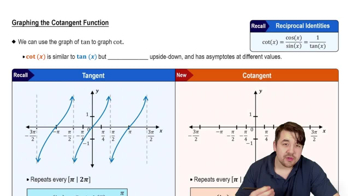
Cotangent Function

The cotangent function, denoted as cot(x), is the reciprocal of the tangent function, defined as cot(x) = cos(x)/sin(x). It is important in trigonometry and calculus, particularly when evaluating limits involving trigonometric functions. Understanding the behavior of cot(x) near specific points, such as 0, is essential for solving limit problems.
Video consigliato:
Percorso guidato
5:37
Introduction to Cotangent Graph