Ch. 4 - Applications of the Derivative
Briggs - Calculus: Early Transcendentals 3rd Edition
Briggs3rd EditionCalculus: Early TranscendentalsISBN: 9780136847243Non è quello che usi tu?Cambia libro di testo
Capitolo 4, Problema 7

For each function ƒ and interval [a, b], a graph of ƒ is given along with the secant line that passes though the graph of ƒ at x = a and x = b.


a. Use the graph to make a conjecture about the value(s) of c satisfying the equation (ƒ(b) - ƒ(a)) / (b-a) = ƒ' (c) .


b. Verify your answer to part (a) by solving the equation (ƒ(b) - ƒ(a)) / (b-a) = ƒ' (c) for c.


ƒ(x) = x⁵/16 ; [-2, 2] <IMAGE>

Guida verificata passo dopo passo
1
Step 1: Understand the Mean Value Theorem (MVT), which states that for a function ƒ that is continuous on the closed interval [a, b] and differentiable on the open interval (a, b), there exists at least one number c in (a, b) such that (ƒ(b) - ƒ(a)) / (b-a) = ƒ'(c).
Step 2: Identify the function and interval given in the problem. Here, the function is ƒ(x) = x⁵/16 and the interval is [-2, 2].
Step 3: Calculate the average rate of change of the function over the interval [-2, 2]. This is given by (ƒ(b) - ƒ(a)) / (b-a), where a = -2 and b = 2.
Step 4: Find the derivative of the function ƒ(x) = x⁵/16. The derivative, ƒ'(x), is obtained by differentiating the function with respect to x.
Step 5: Solve the equation (ƒ(b) - ƒ(a)) / (b-a) = ƒ'(c) for c. This involves setting the average rate of change equal to the derivative and finding the value(s) of c in the interval (-2, 2) that satisfy this equation.

Risposta video verificata per un problema simile:

Questa soluzione video è stata consigliata dai nostri tutor come utile per risolvere questo problema.
Durata del video:
4m

Concetti chiave

Ecco i concetti essenziali che devi comprendere per rispondere correttamente alla domanda.

Mean Value Theorem

The Mean Value Theorem (MVT) states that for a continuous function on a closed interval [a, b] that is differentiable on the open interval (a, b), there exists at least one point c in (a, b) such that the instantaneous rate of change at c (ƒ'(c)) equals the average rate of change over the interval, given by (ƒ(b) - ƒ(a)) / (b - a). This theorem is fundamental in connecting the behavior of a function over an interval to its derivative.
Video consigliato:
Percorso guidato
06:11
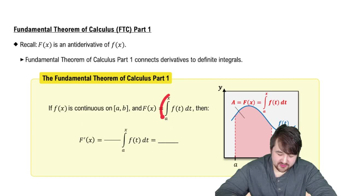
Fundamental Theorem of Calculus Part 1

Secant Line

A secant line is a straight line that intersects a curve at two or more points. In the context of the question, the secant line connects the points (a, ƒ(a)) and (b, ƒ(b)) on the graph of the function ƒ. The slope of this secant line represents the average rate of change of the function over the interval [a, b], which is crucial for applying the Mean Value Theorem.
Video consigliato:
Percorso guidato
05:13
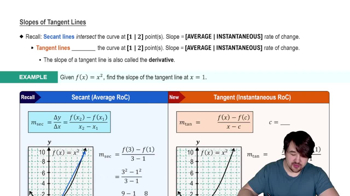
Slopes of Tangent Lines

Derivative

The derivative of a function, denoted as ƒ'(x), represents the instantaneous rate of change of the function at a specific point x. It is defined as the limit of the average rate of change as the interval approaches zero. Understanding derivatives is essential for solving the equation in part (b) of the question, as it allows us to find the value of c where the instantaneous rate of change equals the average rate of change over the interval.
Video consigliato: