
Ch. 4 - Applications of the Derivative
Briggs - Calculus: Early Transcendentals 3rd Edition
Briggs3rd EditionCalculus: Early TranscendentalsISBN: 9780136847243Non è quello che usi tu?Cambia libro di testo
Capitolo 4, Problema 4.4.13g

Let ƒ(x) = (x - 3) (x + 3)²


g. Use your work in parts (a) through (f) to sketch a graph of ƒ.

Guida verificata passo dopo passo
1
Step 1: Begin by expanding the expression (x + 3)². This will help simplify the function ƒ(x). The expansion of (x + 3)² is (x + 3)(x + 3) = x² + 6x + 9.
Step 2: Substitute the expanded form back into the function ƒ(x). The function now becomes ƒ(x) = (x - 3)(x² + 6x + 9)g.
Step 3: Distribute (x - 3) across the expanded polynomial (x² + 6x + 9). This involves multiplying each term in the polynomial by (x - 3), resulting in x³ + 6x² + 9x - 3x² - 18x - 27.
Step 4: Combine like terms from the distribution to simplify the expression further. The simplified form of the function is ƒ(x) = x³ + 3x² - 9x - 27.
Step 5: Analyze the behavior of the function ƒ(x) = x³ + 3x² - 9x - 27. Consider the critical points, inflection points, and intercepts to sketch the graph. Determine where the function is increasing or decreasing, and identify any local maxima or minima.

Risposta video verificata per un problema simile:

Questa soluzione video è stata consigliata dai nostri tutor come utile per risolvere questo problema.
Durata del video:
14m

Concetti chiave

Ecco i concetti essenziali che devi comprendere per rispondere correttamente alla domanda.

Factoring Polynomials

Factoring polynomials involves expressing a polynomial as a product of its simpler components, or factors. In the given function ƒ(x) = (x - 3)(x + 3)², recognizing the factors helps identify the roots of the polynomial, which are the x-values where the function equals zero. This is crucial for sketching the graph, as the roots indicate where the graph intersects the x-axis.
Video consigliato:
6:04
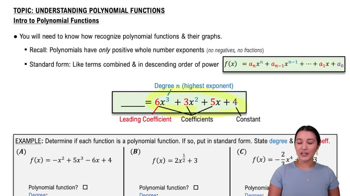
Introduction to Polynomial Functions

Multiplicity of Roots

The multiplicity of a root refers to the number of times a particular root appears in the factored form of a polynomial. In ƒ(x), the root x = -3 has a multiplicity of 2, meaning the graph will touch the x-axis at this point but not cross it. Understanding multiplicity is essential for accurately sketching the behavior of the graph near its roots.
Video consigliato:
03:36
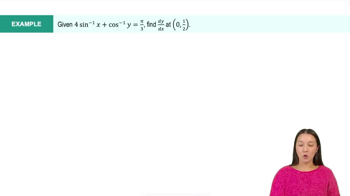
Derivatives of Inverse Sine & Inverse Cosine Example 1

End Behavior of Polynomials

The end behavior of a polynomial describes how the graph behaves as x approaches positive or negative infinity. For the polynomial ƒ(x) = (x - 3)(x + 3)², the leading term determines this behavior. Since the highest degree term is x^3, the graph will rise to positive infinity as x approaches both positive and negative infinity, which is important for sketching the overall shape of the graph.
Video consigliato:
6:04
Introduction to Polynomial Functions
Pratica correlata
Domanda del libro di testo

107–110. {Use of Tech} Motion with gravity Consider the following descriptions of the vertical motion of an object subject only to the acceleration due to gravity. Begin with the acceleration equation a(t) = v' (t) = -g , where g = 9.8 m/s² .

d. Find the time when the object strikes the ground.

A payload is released at an elevation of 400 m from a hot-air balloon that is rising at a rate of 10 m/s.

56
views
Domanda del libro di testo

Interpreting the derivative The graph of f' on the interval [-3,2] is shown in the figure. <IMAGE>


f. Sketch one possible graph of f.

275
views
Domanda del libro di testo

For each function ƒ and interval [a, b], a graph of ƒ is given along with the secant line that passes though the graph of ƒ at x = a and x = b.


a. Use the graph to make a conjecture about the value(s) of c satisfying the equation (ƒ(b) - ƒ(a)) / (b-a) = ƒ' (c) .


b. Verify your answer to part (a) by solving the equation (ƒ(b) - ƒ(a)) / (b-a) = ƒ' (c) for c.


ƒ(x) = x⁵/16 ; [-2, 2] <IMAGE>

168
views
Domanda del libro di testo

Use the graphs of ƒ' and ƒ" to complete the following steps. <IMAGE>

Plot a possible graph of f.

238
views
Domanda del libro di testo

if ƒ(x) = 1 / (3x⁴ + 5) , it can be shown that ƒ'(x) = 12x³ / (3x⁴ + 5)² and ƒ"(x) = 180x² (x² + 1) (x + 1) (x - 1) / (3x⁴ + 5)³ . Use these functions to complete the following steps.


g. Use your work in parts (a) through (f) to sketch a graph of ƒ .

186
views
Domanda del libro di testo

Evaluate lim_x→2 (x³ - 3x² + 2) / (x-2) using l’Hôpital’s Rule and then check your work by evaluating the limit using an appropriate Chapter 2 method.

201
views