Ch. 4 - Applications of the Derivative
Briggs - Calculus: Early Transcendentals 3rd Edition
Briggs3rd EditionCalculus: Early TranscendentalsISBN: 9780136847243Non è quello che usi tu?Cambia libro di testo
Capitolo 4, Problema 4.4.23

Graphing functions Use the guidelines of this section to make a complete graph of f.


f(x) = x³ - 6x² - 135x

Guida verificata passo dopo passo
1
Step 1: Identify the domain of the function f(x) = x³ - 6x² - 135x. Since this is a polynomial function, the domain is all real numbers.
Step 2: Find the critical points by taking the derivative of f(x) to find f'(x). The derivative is f'(x) = 3x² - 12x - 135. Set f'(x) = 0 to find the critical points.
Step 3: Solve the equation 3x² - 12x - 135 = 0 to find the values of x where the function has critical points. Use the quadratic formula or factorization to find these values.
Step 4: Determine the behavior of the function at the critical points by using the second derivative test. Find f''(x) = 6x - 12 and evaluate it at the critical points to determine concavity.
Step 5: Analyze the end behavior of the function by considering the leading term x³. As x approaches positive or negative infinity, the function will behave like x³, which means it will go to positive infinity as x goes to positive infinity and negative infinity as x goes to negative infinity.

Risposta video verificata per un problema simile:

Questa soluzione video è stata consigliata dai nostri tutor come utile per risolvere questo problema.
Durata del video:
10m

Concetti chiave

Ecco i concetti essenziali che devi comprendere per rispondere correttamente alla domanda.

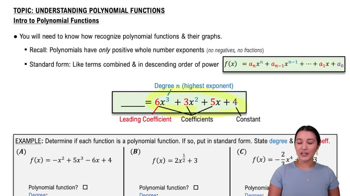
Polynomial Functions

A polynomial function is a mathematical expression involving a sum of powers in one or more variables multiplied by coefficients. In this case, f(x) = x³ - 6x² - 135x is a cubic polynomial, which means its highest degree is three. Understanding the general shape and behavior of polynomial functions is crucial for graphing them effectively.
Video consigliato:
6:04
Introduction to Polynomial Functions

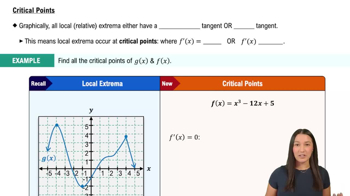
Critical Points and Extrema

Critical points occur where the derivative of a function is zero or undefined, indicating potential local maxima, minima, or points of inflection. To find these points for f(x), we need to compute its derivative, set it to zero, and solve for x. Analyzing these points helps in determining the overall shape and turning points of the graph.
Video consigliato:
04:50
Critical Points

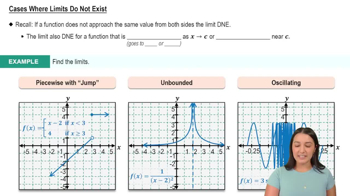
End Behavior

End behavior describes how a function behaves as the input values approach positive or negative infinity. For polynomial functions, the leading term dictates this behavior. In the case of f(x), since the leading term is x³, the graph will rise to positive infinity as x approaches positive infinity and fall to negative infinity as x approaches negative infinity, shaping the overall graph.
Video consigliato:
03:07
Cases Where Limits Do Not Exist