Ch. 4 - Applications of the Derivative
Briggs - Calculus: Early Transcendentals 3rd Edition
Briggs3rd EditionCalculus: Early TranscendentalsISBN: 9780136847243Non è quello che usi tu?Cambia libro di testo
Capitolo 4, Problema 4.6.12

Suppose f is differentiable on (-∞,∞), f(5.99) = 7, and f(6) = 7.002. Use linear approximation to estimate the value of f'(6).

Guida verificata passo dopo passo
1
First, recall the formula for linear approximation: f(x) ≈ f(a) + f'(a)(x - a). This formula is used to approximate the value of a function near a point a using the tangent line at that point.
To estimate f'(6), we can use the concept of the derivative as the slope of the tangent line. The derivative f'(a) is approximately the change in f(x) divided by the change in x, which is (f(x) - f(a)) / (x - a).
In this problem, we are given f(5.99) = 7 and f(6) = 7.002. We can use these values to estimate f'(6) by considering the interval from x = 5.99 to x = 6.
Calculate the change in f(x) over the interval: Δf = f(6) - f(5.99) = 7.002 - 7.
Calculate the change in x over the interval: Δx = 6 - 5.99. Then, use the formula for the derivative: f'(6) ≈ Δf / Δx.

Risposta video verificata per un problema simile:

Questa soluzione video è stata consigliata dai nostri tutor come utile per risolvere questo problema.
Durata del video:
3m

Concetti chiave

Ecco i concetti essenziali che devi comprendere per rispondere correttamente alla domanda.

Differentiability

A function is said to be differentiable at a point if it has a defined derivative at that point, meaning it has a tangent line that approximates its behavior near that point. Differentiability implies continuity, but not vice versa. In this context, since f is differentiable on (-∞,∞), we can apply calculus techniques to analyze its behavior around the point of interest.
Video consigliato:
Percorso guidato
05:53
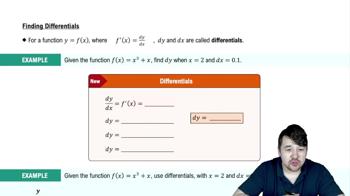
Finding Differentials

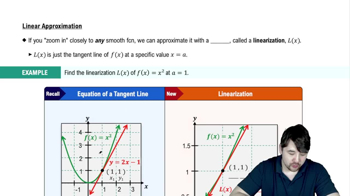
Linear Approximation

Linear approximation is a method used to estimate the value of a function near a given point using the tangent line at that point. The formula for linear approximation is f(x) ≈ f(a) + f'(a)(x - a), where a is the point of tangency. This technique is particularly useful when the function is complex, allowing us to use simpler linear functions to estimate values.
Video consigliato:

Derivative as a Rate of Change

The derivative of a function at a point represents the instantaneous rate of change of the function with respect to its variable at that point. In practical terms, it indicates how much the function's output changes for a small change in input. In this question, estimating f'(6) involves understanding how f changes around x = 6, which is crucial for applying linear approximation effectively.
Video consigliato:
Percorso guidato
04:16
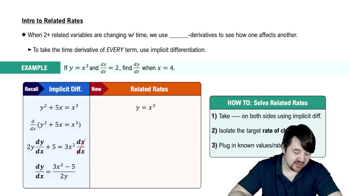
Intro To Related Rates