
Ch. 4 - Applications of the Derivative
Briggs - Calculus: Early Transcendentals 3rd Edition
Briggs3rd EditionCalculus: Early TranscendentalsISBN: 9780136847243Non è quello che usi tu?Cambia libro di testo
Capitolo 4, Problema 4.R.2a

Locating extrema Consider the graph of a function ƒ on the interval [-3, 3]. <IMAGE>
a . Give the approximate coordinates of the local maxima and minima of ƒ

Guida verificata passo dopo passo
1
Identify the critical points of the function ƒ by finding where the derivative ƒ'(x) is zero or undefined within the interval [-3, 3].
Evaluate the function ƒ at each critical point to determine the function values at these points.
Examine the endpoints of the interval, x = -3 and x = 3, by evaluating ƒ at these points to ensure no extrema are missed.
Compare the function values at the critical points and endpoints to determine which are local maxima and which are local minima.
Approximate the coordinates of the local maxima and minima by identifying the x-values where the function has the highest and lowest values, respectively, and pairing them with their corresponding function values.

Risposta video verificata per un problema simile:

Questa soluzione video è stata consigliata dai nostri tutor come utile per risolvere questo problema.
Durata del video:
2m

Concetti chiave

Ecco i concetti essenziali che devi comprendere per rispondere correttamente alla domanda.

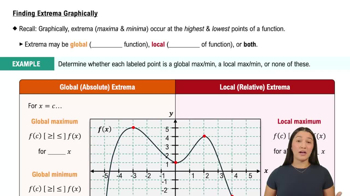
Local Extrema

Local extrema refer to the points on a function where it reaches a local maximum or minimum value within a specific interval. A local maximum is a point where the function value is higher than its immediate neighbors, while a local minimum is where it is lower. Identifying these points often involves analyzing the function's derivative.
Video consigliato:
05:58
Finding Extrema Graphically

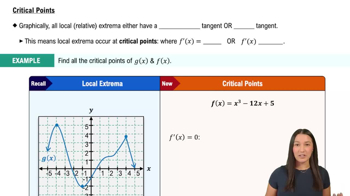
Critical Points

Critical points are values in the domain of a function where its derivative is either zero or undefined. These points are essential for finding local extrema, as they indicate where the function's slope changes, potentially leading to maxima or minima. Evaluating the function at these points helps determine their nature.
Video consigliato:
04:50
Critical Points

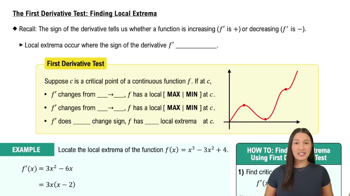
First Derivative Test

The First Derivative Test is a method used to classify critical points as local maxima, local minima, or neither. By examining the sign of the derivative before and after a critical point, one can determine whether the function is increasing or decreasing, thus identifying the nature of the extrema. This test is a fundamental tool in calculus for analyzing function behavior.
Video consigliato:
07:09
The First Derivative Test: Finding Local Extrema