Ch. 4 - Applications of the Derivative
Briggs - Calculus: Early Transcendentals 3rd Edition
Briggs3rd EditionCalculus: Early TranscendentalsISBN: 9780136847243Non è quello che usi tu?Cambia libro di testo
Capitolo 4, Problema 4.R.44

Minimum painting surface A metal cistern in the shape of a right circular cylinder with volume V = 50 m³ needs to be painted each year to reduce corrosion. The paint is applied only to surfaces exposed to the elements (the outside cylinder wall and the circular top). Find the dimensions r and h of the cylinder that minimize the area of the painted surfaces.

Guida verificata passo dopo passo
1
Start by identifying the formulas needed: The volume of a cylinder is given by \( V = \pi r^2 h \) and the surface area to be painted (the lateral surface area plus the top) is \( A = 2\pi r h + \pi r^2 \).
Since the volume \( V = 50 \) m³ is given, express the height \( h \) in terms of the radius \( r \) using the volume formula: \( h = \frac{V}{\pi r^2} = \frac{50}{\pi r^2} \).
Substitute \( h \) from the previous step into the surface area formula to express \( A \) solely in terms of \( r \): \( A(r) = 2\pi r \left(\frac{50}{\pi r^2}\right) + \pi r^2 \). Simplify this expression.
Differentiate the simplified surface area function \( A(r) \) with respect to \( r \) to find \( A'(r) \). This will help identify the critical points where the surface area could be minimized.
Set the derivative \( A'(r) \) equal to zero and solve for \( r \) to find the critical points. Use the second derivative test or analyze the behavior of \( A'(r) \) to confirm that the critical point corresponds to a minimum surface area. Once \( r \) is found, use the expression for \( h \) to find the corresponding height.

Risposta video verificata per un problema simile:

Questa soluzione video è stata consigliata dai nostri tutor come utile per risolvere questo problema.
Durata del video:
7m

Concetti chiave

Ecco i concetti essenziali che devi comprendere per rispondere correttamente alla domanda.

Volume of a Cylinder

The volume of a right circular cylinder is calculated using the formula V = πr²h, where r is the radius and h is the height. In this problem, the volume is fixed at 50 m³, which means that any solution must satisfy this equation. Understanding how to manipulate this formula is essential for relating the dimensions of the cylinder to its volume.
Video consigliato:
08:29
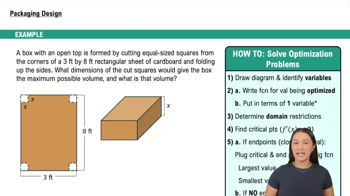
Example 5: Packaging Design

Surface Area of a Cylinder

The surface area of a right circular cylinder consists of the lateral area and the area of the circular top. The formula for the total surface area A is A = 2πrh + πr², where the first term represents the lateral surface area and the second term accounts for the top. Minimizing this surface area while maintaining a constant volume is the core objective of the problem.
Video consigliato:
09:07
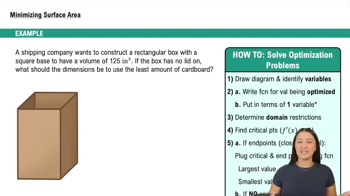
Example 1: Minimizing Surface Area

Optimization Techniques

Optimization in calculus involves finding the maximum or minimum values of a function. In this context, we will use techniques such as setting up a function for the surface area in terms of one variable (using the volume constraint) and applying derivatives to find critical points. Understanding how to apply the first and second derivative tests is crucial for determining the dimensions that minimize the painted surface area.
Video consigliato:
10:13
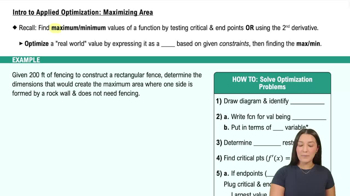
Intro to Applied Optimization: Maximizing Area