

Ch. 4 - Applications of the Derivative
Briggs - Calculus: Early Transcendentals 3rd Edition
Briggs3rd EditionCalculus: Early TranscendentalsISBN: 9780136847243Non è quello che usi tu?Cambia libro di testo
Capitolo 4, Problema 4.3.92

Second Derivative Test Locate the critical points of the following functions. Then use the Second Derivative Test to determine (if possible) whether they correspond to local maxima or local minima.


f(x) = x³ - 13x² - 9x

Guida verificata passo dopo passo
1
First, find the first derivative of the function f(x) = x³ - 13x² - 9x. The first derivative, f'(x), is obtained by differentiating each term: f'(x) = 3x² - 26x - 9.
Next, locate the critical points by setting the first derivative equal to zero and solving for x: 3x² - 26x - 9 = 0. Use the quadratic formula x = (-b ± √(b² - 4ac)) / 2a, where a = 3, b = -26, and c = -9, to find the values of x.
Once the critical points are found, calculate the second derivative of the function to apply the Second Derivative Test. The second derivative, f''(x), is obtained by differentiating f'(x): f''(x) = 6x - 26.
Evaluate the second derivative at each critical point. If f''(x) > 0 at a critical point, the function has a local minimum there. If f''(x) < 0, the function has a local maximum. If f''(x) = 0, the test is inconclusive.
Summarize the results by stating which critical points correspond to local maxima or minima based on the sign of the second derivative at those points.

Risposta video verificata per un problema simile:

Questa soluzione video è stata consigliata dai nostri tutor come utile per risolvere questo problema.
Durata del video:
5m

Concetti chiave

Ecco i concetti essenziali che devi comprendere per rispondere correttamente alla domanda.

Critical Points

Critical points of a function occur where its first derivative is zero or undefined. These points are essential for identifying potential local maxima and minima, as they represent locations where the function's slope changes. To find critical points, one must differentiate the function and solve for the values of x that satisfy the condition f'(x) = 0.
Video consigliato:
04:50
Critical Points

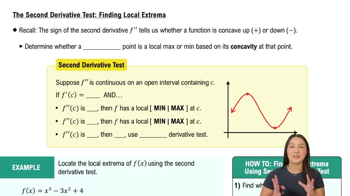
Second Derivative Test

The Second Derivative Test is a method used to classify critical points as local maxima, local minima, or saddle points. It involves evaluating the second derivative of the function at the critical points. If f''(x) > 0, the point is a local minimum; if f''(x) < 0, it is a local maximum; and if f''(x) = 0, the test is inconclusive.
Video consigliato:
06:02
The Second Derivative Test: Finding Local Extrema

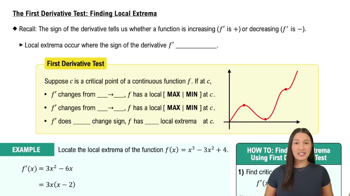
Local Maxima and Minima

Local maxima and minima refer to the highest and lowest points in a specific neighborhood of a function's graph. A local maximum is a point where the function value is greater than that of nearby points, while a local minimum is where it is lower. Understanding these concepts is crucial for analyzing the behavior of functions and their applications in optimization problems.
Video consigliato:
07:09
The First Derivative Test: Finding Local Extrema
Pratica correlata
Domanda del libro di testo

5–7. For each function ƒ and interval [a, b], a graph of ƒ is given along with the secant line that passes though the graph of ƒ at x = a and x = b.


a. Use the graph to make a conjecture about the value(s) of c satisfying the equation (ƒ(b) - ƒ(a)) / (b-a) = ƒ' (c) .


b. Verify your answer to part (a) by solving the equation (ƒ(b) - ƒ(a)) / (b-a) = ƒ' (c) for c.


ƒ(x) = x² / 4 + 1 ; [ -2, 4] <IMAGE>

203
views
Domanda del libro di testo

Mean Value Theorem and the police A state patrol officer saw a car start from rest at a highway on-ramp. She radioed ahead to a patrol officer 30 mi along the highway. When the car reached the location of the second officer 28 min later, it was clocked going 60 mi/hr. The driver of the car was given a ticket for exceeding the 60-mi/hr speed limit. Why can the officer conclude that the driver exceeded the speed limit?

311
views
Domanda del libro di testo

Closest point on a curve What point on the parabola y = 1 - x² is closest to the point (1, 1)?

303
views
Domanda del libro di testo

Shortest ladder A 10-ft-tall fence runs parallel to the wall of a house at a distance of 4 ft. Find the length of the shortest ladder that extends from the ground to the house without touching the fence. Assume the vertical wall of the house and the horizontal ground have infinite extent.

333
views
1
rank
Domanda del libro di testo

17–83. Limits Evaluate the following limits. Use l’Hôpital’s Rule when it is convenient and applicable.


lim_x→π (cos x +1 ) / (x - π )²

202
views
Domanda del libro di testo

Crankshaft A crank of radius r rotates with an angular frequency w It is connected to a piston by a connecting rod of length L (see figure). The acceleration of the piston varies with the position of the crank according to the function <IMAGE>


a (Θ) = w²r (cos Θ + (r cos2Θ) / L) .


For fixed w , L, and r find the values of Θ, with 0 ≤ Θ ≤ 2π , for which the acceleration of the piston is a maximum and minimum.

221
views