

Ch. 4 - Applications of the Derivative
Briggs - Calculus: Early Transcendentals 3rd Edition
Briggs3rd EditionCalculus: Early TranscendentalsISBN: 9780136847243Non è quello che usi tu?Cambia libro di testo
Capitolo 4, Problema 4.4.11

Sketch a continuous function f on some interval that has the properties described. Answers will vary.


The function f satisfies f'(-2) = 2, f'(0) = 0, f'(1) = -3 and f'(4) = 1.

Guida verificata passo dopo passo
1
Understand that f'(x) represents the derivative of the function f(x), which gives the slope of the tangent line to the curve at any point x. The given values of f'(x) indicate the slope of the function at specific points.
At x = -2, f'(-2) = 2, which means the slope of the tangent line to the function at x = -2 is 2. This suggests that the function is increasing at this point.
At x = 0, f'(0) = 0, indicating that the slope of the tangent line is zero. This typically means there is a horizontal tangent line at this point, suggesting a local maximum or minimum.
At x = 1, f'(1) = -3, which means the slope of the tangent line is -3. This indicates that the function is decreasing at this point.
At x = 4, f'(4) = 1, indicating that the slope of the tangent line is 1. This suggests that the function is increasing at this point. Use these slopes to sketch a function that transitions smoothly through these points, ensuring continuity.

Risposta video verificata per un problema simile:

Questa soluzione video è stata consigliata dai nostri tutor come utile per risolvere questo problema.
Durata del video:
3m

Concetti chiave

Ecco i concetti essenziali che devi comprendere per rispondere correttamente alla domanda.

Derivative

The derivative of a function at a point measures the rate at which the function's value changes as its input changes. It is represented as f'(x) and provides information about the function's slope at that specific point. Understanding the values of the derivative at given points helps in determining the function's behavior, such as increasing or decreasing intervals.
Video consigliato:

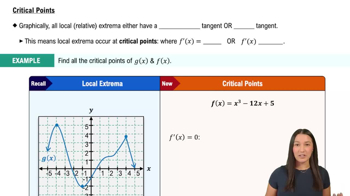
Critical Points

Critical points occur where the derivative of a function is zero or undefined. These points are significant because they can indicate local maxima, minima, or points of inflection. In the context of the given question, f'(0) = 0 suggests a critical point, which is essential for sketching the function and understanding its overall shape.
Video consigliato:
04:50
Critical Points

Continuity

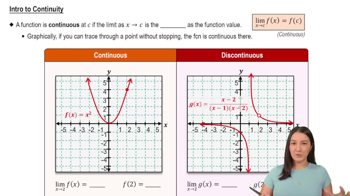
A function is continuous on an interval if there are no breaks, jumps, or holes in its graph. This property ensures that the function can be drawn without lifting the pencil from the paper. For the function f in the question, being continuous means that it must smoothly connect the points defined by the derivative values, influencing how the function is sketched across the specified interval.
Video consigliato:
05:34
Intro to Continuity
Pratica correlata
Domanda del libro di testo

{Use of Tech} Fixed points An important question about many functions concerns the existence and location of fixed points. A fixed point of f is a value of x that satisfies the equation f(x) = x; it corresponds to a point at which the graph of f intersects the line y = x. Find all the fixed points of the following functions. Use preliminary analysis and graphing to determine good initial approximations.


f(x) = cos x

241
views
Domanda del libro di testo

Differentials Consider the following functions and express the relationship between a small change in x and the corresponding change in y in the form dy = f'(x)dx.


f(x) = sin² x

198
views
Domanda del libro di testo

Suppose f is differentiable on (-∞,∞) and f(5.01) - f(5) = 0.25.Use linear approximation to estimate the value of f'(5).

249
views
Domanda del libro di testo

17–83. Limits Evaluate the following limits. Use l’Hôpital’s Rule when it is convenient and applicable.


lim_x→1⁻ (1-x) tan πx/2

242
views
Domanda del libro di testo

Second Derivative Test Locate the critical points of the following functions. Then use the Second Derivative Test to determine (if possible) whether they correspond to local maxima or local minima.


f(x) = 2x⁻³ - x⁻²

196
views
Domanda del libro di testo

Suppose the position of an object moving horizontally after seconds is given by the function s(t) = 32t - t⁴, where 0 ≤ t ≤ 3 and s is measured in feet, with s > 0 corresponding to positions to the right of the origin. When is the object farthest to the right?

288
views