Ch. 4 - Applications of the Derivative
Briggs - Calculus: Early Transcendentals 3rd Edition
Briggs3rd EditionCalculus: Early TranscendentalsISBN: 9780136847243Non è quello che usi tu?Cambia libro di testo
Capitolo 4, Problema 4.8.49

{Use of Tech} Fixed points An important question about many functions concerns the existence and location of fixed points. A fixed point of f is a value of x that satisfies the equation f(x) = x; it corresponds to a point at which the graph of f intersects the line y = x. Find all the fixed points of the following functions. Use preliminary analysis and graphing to determine good initial approximations.


f(x) = cos x

Guida verificata passo dopo passo
1
Understand the concept of a fixed point: A fixed point of a function f(x) is a value x such that f(x) = x. For the function f(x) = cos(x), we need to find x such that cos(x) = x.
Graph the function y = cos(x) and the line y = x on the same set of axes. The points where these two graphs intersect are the fixed points of the function.
Perform a preliminary analysis by considering the behavior of the cosine function. Note that cos(x) oscillates between -1 and 1, while the line y = x is a straight line with a slope of 1. This suggests that fixed points, if they exist, will be within the interval [-1, 1].
Use a numerical method, such as the fixed-point iteration method, to approximate the fixed points. Start with an initial guess within the interval [-1, 1], such as x_0 = 0.5, and iterate using the formula x_{n+1} = cos(x_n) until the values converge to a stable point.
Verify the solution by checking if the value obtained satisfies the equation cos(x) = x to a desired level of accuracy. This can be done by substituting the value back into the equation and ensuring the left and right sides are approximately equal.

Risposta video verificata per un problema simile:

Questa soluzione video è stata consigliata dai nostri tutor come utile per risolvere questo problema.
Durata del video:
2m

Concetti chiave

Ecco i concetti essenziali che devi comprendere per rispondere correttamente alla domanda.

Fixed Points

A fixed point of a function f is a value x such that f(x) = x. This means that when the function is applied to this value, it returns the same value. Graphically, fixed points are where the graph of the function intersects the line y = x. Identifying fixed points is crucial in various applications, including iterative methods and stability analysis.
Video consigliato:
04:50
Critical Points

Graphing Functions

Graphing functions involves plotting the values of a function on a coordinate system to visualize its behavior. This technique helps in identifying key features such as intercepts, maxima, minima, and fixed points. For the function f(x) = cos x, graphing allows us to see where the curve intersects the line y = x, providing insights into the location of fixed points.
Video consigliato:
Percorso guidato
5:53
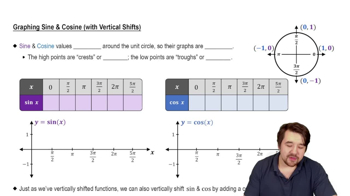
Graph of Sine and Cosine Function

Preliminary Analysis

Preliminary analysis refers to the initial examination of a function to gather information about its behavior before performing detailed calculations. This can include evaluating the function at specific points, analyzing its derivatives, and understanding its general shape. For f(x) = cos x, preliminary analysis can help estimate where fixed points might be located, guiding further investigation.
Video consigliato:
Percorso guidato
06:29
Derivatives Applied To Velocity