

Ch. 4 - Applications of the Derivative
Briggs - Calculus: Early Transcendentals 3rd Edition
Briggs3rd EditionCalculus: Early TranscendentalsISBN: 9780136847243Non è quello che usi tu?Cambia libro di testo
Capitolo 4, Problema 4.6.37

Use linear approximations to estimate the following quantities. Choose a value of a to produce a small error.
1/203

Guida verificata passo dopo passo
1
Identify the function you want to approximate. In this case, we are approximating f(x) = 1/x at x = 203.
Choose a value of 'a' close to 203 where the function is easy to compute. A good choice is a = 200, since 1/200 is straightforward to calculate.
Find the derivative of the function f(x) = 1/x. The derivative is f'(x) = -1/x^2.
Use the linear approximation formula: L(x) = f(a) + f'(a)(x - a). Substitute a = 200 into the formula.
Calculate L(203) using the values from the previous steps: L(203) = 1/200 + (-1/200^2)(203 - 200). This will give you the linear approximation of 1/203.

Risposta video verificata per un problema simile:

Questa soluzione video è stata consigliata dai nostri tutor come utile per risolvere questo problema.
Durata del video:
4m

Concetti chiave

Ecco i concetti essenziali che devi comprendere per rispondere correttamente alla domanda.

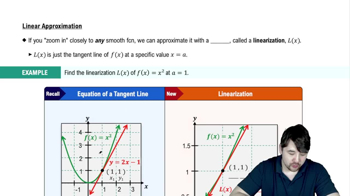
Linear Approximation

Linear approximation is a method used to estimate the value of a function near a given point using the tangent line at that point. It is based on the idea that a function can be closely approximated by a linear function when the input is near a specific value. The formula for linear approximation is f(a) + f'(a)(x - a), where f'(a) is the derivative at point a.
Video consigliato:

Derivatives

The derivative of a function at a point measures the rate at which the function's value changes as its input changes. It is a fundamental concept in calculus that provides information about the slope of the tangent line to the function at that point. Understanding derivatives is crucial for applying linear approximation, as they are used to determine the slope of the tangent line.
Video consigliato:

Choosing a Value for a

Selecting an appropriate value for 'a' in linear approximation is essential for minimizing error in the estimate. Ideally, 'a' should be a value close to the point of interest (in this case, 203) where the function is easy to evaluate. A well-chosen 'a' leads to a more accurate linear approximation, as the tangent line will closely follow the curve of the function near that point.
Video consigliato:
Percorso guidato
06:37
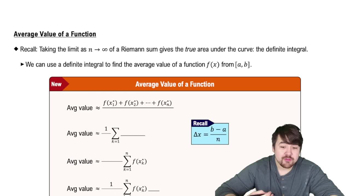
Average Value of a Function
Pratica correlata
Domanda del libro di testo

Functions from derivatives Use the derivative f' to determine the x-coordinates of the local maxima and minima of f, and the intervals on which f is increasing or decreasing. Sketch a possible graph of f (f is not unique).


f'(x) = 10 sin 2x on [-2π, 2π]

274
views
Domanda del libro di testo

23–68. Indefinite integrals Determine the following indefinite integrals. Check your work by differentiation.


∫ ((2 + 3 cos y)/sin² y)dy

72
views
Domanda del libro di testo

23–68. Indefinite integrals Determine the following indefinite integrals. Check your work by differentiation.


∫ (3/x⁴ + 2 - 3/x²)

89
views
Domanda del libro di testo

Trajectory high point A stone is launched vertically upward from a cliff 192 ft above the ground at a speed of 64 ft/s. Its height above the ground t seconds after the launch is given by s = -16t² + 64t + 192, for 0 ≤ t ≤ 6. When does the stone reach its maximum height?

258
views
Domanda del libro di testo

Evaluate the following limits. Use l’Hôpital’s Rule when it is convenient and applicable.


lim_x→ 0 (eˣ - 1) / (x² + 3x)

272
views
Domanda del libro di testo

{Use of Tech} Finding roots with Newton’s method For the given function f and initial approximation x₀, use Newton’s method to approximate a root of f. Stop calculating approximations when two successive approximations agree to five digits to the right of the decimal point after rounding. Show your work by making a table similar to that in Example 1.


f(x) = tan x - 2x; x₀ = 1.2

263
views