Ch. 4 - Applications of the Derivative
Briggs - Calculus: Early Transcendentals 3rd Edition
Briggs3rd EditionCalculus: Early TranscendentalsISBN: 9780136847243Non è quello che usi tu?Cambia libro di testo
Capitolo 4, Problema 4.9.41

23–68. Indefinite integrals Determine the following indefinite integrals. Check your work by differentiation.


∫ ((2 + 3 cos y)/sin² y)dy

Guida verificata passo dopo passo
1
Step 1: Break down the integral into simpler components. Rewrite the integrand as (2/sin²y) + (3 cos y/sin²y). This allows us to handle each term separately.
Step 2: Recognize that 2/sin²y can be rewritten using a trigonometric identity. Recall that 1/sin²y = csc²y, so 2/sin²y becomes 2 csc²y.
Step 3: For the second term, 3 cos y/sin²y, rewrite it as 3 (cos y/sin²y). Notice that cos y/sin²y can be expressed as 3 cot y csc y using trigonometric identities.
Step 4: Now, the integral becomes ∫ (2 csc²y + 3 cot y csc y) dy. Split the integral into two parts: ∫ 2 csc²y dy + ∫ 3 cot y csc y dy.
Step 5: Use standard integration formulas: ∫ csc²y dy = -cot y and ∫ cot y csc y dy = -csc y. Apply these formulas to each term and combine the results, adding the constant of integration (C) at the end.

Risposta video verificata per un problema simile:

Questa soluzione video è stata consigliata dai nostri tutor come utile per risolvere questo problema.
Durata del video:
3m

Concetti chiave

Ecco i concetti essenziali che devi comprendere per rispondere correttamente alla domanda.

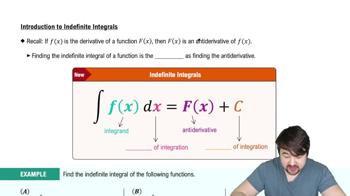
Indefinite Integrals

Indefinite integrals represent a family of functions whose derivative is the integrand. They are expressed without limits and include a constant of integration, typically denoted as 'C'. The process of finding an indefinite integral is known as integration, which is the reverse operation of differentiation.
Video consigliato:
Percorso guidato
05:04
Introduction to Indefinite Integrals

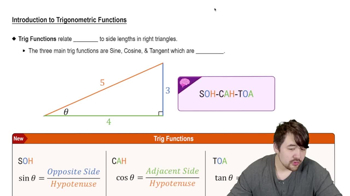
Trigonometric Functions

Trigonometric functions, such as sine and cosine, are fundamental in calculus, especially in integration and differentiation. In the given integral, 'cos y' and 'sin² y' are trigonometric functions that can often be simplified or transformed using identities, aiding in the integration process.
Video consigliato:
Percorso guidato
6:04
Introduction to Trigonometric Functions

Integration Techniques

Various techniques exist for solving integrals, including substitution, integration by parts, and partial fraction decomposition. For the integral ∫ ((2 + 3 cos y)/sin² y)dy, recognizing the structure of the integrand allows for the application of these techniques, facilitating the integration process.
Video consigliato:
Percorso guidato
06:18
Integration by Parts for Definite Integrals
Pratica correlata
Domanda del libro di testo

Use linear approximations to estimate the following quantities. Choose a value of a to produce a small error.

1/203

316
views

Domanda del libro di testo

Functions from derivatives Use the derivative f' to determine the x-coordinates of the local maxima and minima of f, and the intervals on which f is increasing or decreasing. Sketch a possible graph of f (f is not unique).


f'(x) = 10 sin 2x on [-2π, 2π]

274
views
Domanda del libro di testo

23–68. Indefinite integrals Determine the following indefinite integrals. Check your work by differentiation.


∫ (3/x⁴ + 2 - 3/x²)

89
views
Domanda del libro di testo

Cylinder and cones (Putnam Exam 1938) Right circular cones of height h and radius r are attached to each end of a right circular cylinder of height h and radius r, forming a double-pointed object. For a given surface area A, what are the dimensions r and h that maximize the volume of the object?

325
views
Domanda del libro di testo

49–54. {Use of Tech} Graphing with technology Make a complete graph of the following functions. A graphing utility is useful in locating intercepts, local extreme values, and inflection points.


ƒ(x) = 1/3 x³ - 2x² - 5x + 2

171
views
Domanda del libro di testo

Trajectory high point A stone is launched vertically upward from a cliff 192 ft above the ground at a speed of 64 ft/s. Its height above the ground t seconds after the launch is given by s = -16t² + 64t + 192, for 0 ≤ t ≤ 6. When does the stone reach its maximum height?

258
views