Ch. 5 - Integration
Briggs - Calculus: Early Transcendentals 3rd Edition
Briggs3rd EditionCalculus: Early TranscendentalsISBN: 9780136847243Non è quello che usi tu?Cambia libro di testo
Capitolo 5, Problema 5.1.9

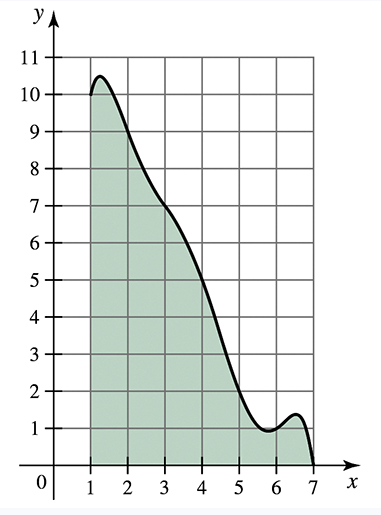
Approximating area from a graph Approximate the area of the region bounded by the graph (see figure) and the 𝓍-axis by dividing the interval [1, 7] into n = 6 subintervals. Use a left and right Riemann sum to obtain two different approximations.                                                                                                                                                                         
fig

Guida verificata passo dopo passo
1
First, determine the width of each subinterval by dividing the total interval length by the number of subintervals: \(\Delta x = \frac{7 - 1}{6} = 1\).
Identify the left endpoints of each subinterval for the left Riemann sum: these are \(x = 1, 2, 3, 4, 5, 6\). For each of these points, find the corresponding function values \(f(x)\) from the graph.
Calculate the left Riemann sum by multiplying each function value at the left endpoints by the width \(\Delta x\) and summing them up: \(L = \sum_{i=0}^{5} f(x_i) \Delta x\) where \(x_i\) are the left endpoints.
Identify the right endpoints of each subinterval for the right Riemann sum: these are \(x = 2, 3, 4, 5, 6, 7\). For each of these points, find the corresponding function values \(f(x)\) from the graph.
Calculate the right Riemann sum by multiplying each function value at the right endpoints by the width \(\Delta x\) and summing them up: \(R = \sum_{i=1}^{6} f(x_i) \Delta x\) where \(x_i\) are the right endpoints.

Risposta video verificata per un problema simile:

Questa soluzione video è stata consigliata dai nostri tutor come utile per risolvere questo problema.
Durata del video:
3m

Concetti chiave

Ecco i concetti essenziali che devi comprendere per rispondere correttamente alla domanda.

Riemann Sums

Riemann sums approximate the area under a curve by dividing the interval into subintervals and summing the areas of rectangles. The height of each rectangle is determined by the function value at specific points, such as the left or right endpoints of each subinterval.
Video consigliato:
Percorso guidato
06:11
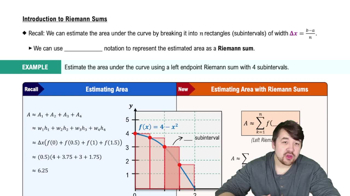
Introduction to Riemann Sums

Left and Right Endpoint Approximations

Left and right Riemann sums use the function values at the left or right endpoints of each subinterval to determine rectangle heights. Left sums may underestimate or overestimate the area depending on the function's behavior, while right sums provide a complementary approximation.
Video consigliato:
Percorso guidato
07:39
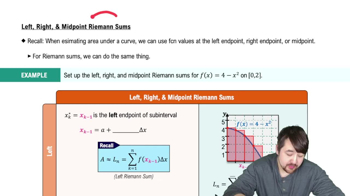
Left, Right, & Midpoint Riemann Sums

Partitioning the Interval

Dividing the interval [1, 7] into n = 6 equal subintervals means each subinterval has width Δx = (7-1)/6 = 1. This partitioning is essential for calculating the Riemann sums, as it defines the base of each rectangle used in the approximation.
Video consigliato:
08:44
Interval of Convergence
Pratica correlata
Domanda del libro di testo

Indefinite integrals Use a change of variables or Table 5.6 to evaluate the following indefinite integrals. Check your work by differentiating.                                                                                  


 ∫ sec 4w tan 4w dw

55
views

Domanda del libro di testo

Symmetry in integrals Use symmetry to evaluate the following integrals.

∫²₋₂ [(x³ ― 4x) / (x² + 1)] dx 

134
views
Domanda del libro di testo

Average distance on a triangle Consider the right triangle with vertices (0,0) ,(0,b) , and (a,0) , where a > 0 and b > 0. Show that the average vertical distance from points on the 𝓍-axis to the hypotenuse is b/2 , for all a > 0 .

49
views
Domanda del libro di testo

Symmetry in integrals Use symmetry to evaluate the following integrals.

∫²⁰⁰₋₂₀₀ 2x⁵ dx

109
views
Domanda del libro di testo

Definite integrals Evaluate the following integrals using the Fundamental Theorem of Calculus


∫¹₁/₂ (t⁻³ ― 8) dt

58
views
Domanda del libro di testo

Derivatives of integrals Simplify the following expressions.


d/dy ∫¹⁰ᵧ³ √(𝓍⁶ + 1) d𝓍

118
views