Ch. 5 - Integration
Briggs - Calculus: Early Transcendentals 3rd Edition
Briggs3rd EditionCalculus: Early TranscendentalsISBN: 9780136847243Non è quello che usi tu?Cambia libro di testo
Capitolo 5, Problema 5.3.82

Derivatives of integrals Simplify the following expressions.


d/dy ∫¹⁰ᵧ³ √(𝓍⁶ + 1) d𝓍

Guida verificata passo dopo passo
1
Step 1: Recognize that the problem involves the Fundamental Theorem of Calculus, which states that if F(x) is the antiderivative of f(x), then d/dx ∫ₐˣ f(t) dt = f(x).
Step 2: Observe that the integral has variable limits of integration (y³ as the lower limit and 10 as the upper limit). This requires the use of Leibniz's rule for differentiation under the integral sign.
Step 3: Apply Leibniz's rule: d/dy ∫ₐᵇ f(x) dx = f(b) * (db/dy) - f(a) * (da/dy), where a and b are functions of y. Here, a = y³ and b = 10.
Step 4: Substitute the limits into the formula. The upper limit (10) is constant, so db/dy = 0. For the lower limit (y³), da/dy = d(y³)/dy = 3y². The integrand is √(x⁶ + 1), so evaluate it at x = y³.
Step 5: Simplify the expression using the formula: d/dy ∫¹⁰ᵧ³ √(x⁶ + 1) dx = -√((y³)⁶ + 1) * 3y². The negative sign comes from the lower limit contribution.

Risposta video verificata per un problema simile:

Questa soluzione video è stata consigliata dai nostri tutor come utile per risolvere questo problema.
Durata del video:
2m

Concetti chiave

Ecco i concetti essenziali che devi comprendere per rispondere correttamente alla domanda.

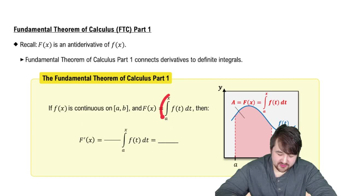
Fundamental Theorem of Calculus

The Fundamental Theorem of Calculus links differentiation and integration, stating that if F is an antiderivative of f on an interval [a, b], then the integral of f from a to b can be computed using F. It also establishes that the derivative of the integral of a function is the original function itself, which is crucial for simplifying expressions involving derivatives of integrals.
Video consigliato:
Percorso guidato
06:11
Fundamental Theorem of Calculus Part 1

Chain Rule

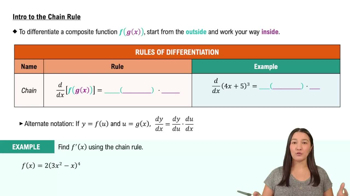
The Chain Rule is a fundamental principle in calculus used to differentiate composite functions. When differentiating an integral with variable limits, the Chain Rule helps in applying the derivative to the upper limit while also considering the derivative of the limit itself. This is essential for correctly simplifying expressions where the limits of integration are functions of a variable.
Video consigliato:
05:02
Intro to the Chain Rule

Definite Integral

A definite integral represents the accumulation of quantities, such as area under a curve, over a specific interval [a, b]. In the context of the given expression, understanding how to evaluate definite integrals and their properties is necessary for simplifying the expression involving the integral of √(𝓍⁶ + 1) from 1 to 3y. This knowledge is key to applying the Fundamental Theorem of Calculus effectively.
Video consigliato:
Percorso guidato
05:43
Definition of the Definite Integral
Pratica correlata
Domanda del libro di testo

Use a substitution of the form u = a𝓍 + b to evaluate the following indefinite integrals

∫(e³ˣ ⁺¹ d𝓍

61
views

Domanda del libro di testo

Average distance on a triangle Consider the right triangle with vertices (0,0) ,(0,b) , and (a,0) , where a > 0 and b > 0. Show that the average vertical distance from points on the 𝓍-axis to the hypotenuse is b/2 , for all a > 0 .

49
views
Domanda del libro di testo

Approximating area from a graph Approximate the area of the region bounded by the graph (see figure) and the 𝓍-axis by dividing the interval [1, 7] into n = 6 subintervals. Use a left and right Riemann sum to obtain two different approximations.                                                                                                                                                                         

74
views
Domanda del libro di testo

Definite integrals Evaluate the following integrals using the Fundamental Theorem of Calculus


∫¹₁/₂ (t⁻³ ― 8) dt

58
views
Domanda del libro di testo

Definite integrals Use a change of variables or Table 5.6 to evaluate the following definite integrals.                                                                                                                         


 ∫π/₁₆^π/⁸ 8 csc² 4𝓍 d𝓍

100
views
Domanda del libro di testo

Areas of regions Find the area of the following regions.                                                                                                                   

                                                                                                                                                                 The region bounded by the graph of ƒ(𝓍) = (𝓍―4)⁴ and the 𝓍-axis between and 𝓍 = 2 and 𝓍= 6

63
views