Ch. 5 - Integration
Briggs - Calculus: Early Transcendentals 3rd Edition
Briggs3rd EditionCalculus: Early TranscendentalsISBN: 9780136847243Non è quello che usi tu?Cambia libro di testo
Capitolo 5, Problema 5.R.105a

Area functions and the Fundamental Theorem Consider the function
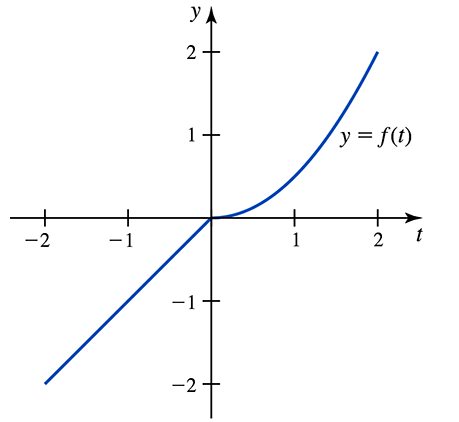
ƒ(t) = { t      if  ―2 ≤ t < 0
t²/2    if    0 ≤ t ≤ 2
and its graph shown below. Let F(𝓍) = ∫₋₁ˣ ƒ(t) dt and G(𝓍) = ∫₋₂ˣ ƒ(t) dt.                                                                                                               
                                                                                                                                                                               
fig


(a) Evaluate F(―2) and F(2).

Guida verificata passo dopo passo
1
Step 1: Understand the problem. We are tasked with evaluating F(-2) and F(2), where F(𝓍) = ∫₋₁ˣ ƒ(t) dt. This involves calculating the definite integral of the given piecewise function ƒ(t) over specific intervals.
Step 2: Analyze the function ƒ(t). The function is defined as ƒ(t) = t for -2 ≤ t < 0, and ƒ(t) = t²/2 for 0 ≤ t ≤ 2. The graph confirms this piecewise definition.
Step 3: Evaluate F(-2). To compute F(-2), note that the integral starts at t = -1 and ends at t = -2. Since the interval is reversed (upper limit is smaller than the lower limit), the integral will have a negative sign. Use the definition of ƒ(t) = t for this interval and integrate.
Step 4: Evaluate F(2). To compute F(2), note that the integral starts at t = -1 and ends at t = 2. Break the integral into two parts: ∫₋₁⁰ ƒ(t) dt (where ƒ(t) = t) and ∫₀² ƒ(t) dt (where ƒ(t) = t²/2). Compute each integral separately and sum the results.
Step 5: Apply the Fundamental Theorem of Calculus. For each integral, find the antiderivative of ƒ(t), evaluate it at the bounds of integration, and subtract the values. This will give the expressions for F(-2) and F(2).

Risposta video verificata per un problema simile:

Questa soluzione video è stata consigliata dai nostri tutor come utile per risolvere questo problema.
Durata del video:
8m

Concetti chiave

Ecco i concetti essenziali che devi comprendere per rispondere correttamente alla domanda.

Definite Integral

A definite integral represents the signed area under a curve defined by a function over a specific interval. It is denoted as ∫[a,b] f(t) dt, where 'a' and 'b' are the limits of integration. The value of the definite integral can be interpreted as the accumulation of quantities, such as area, over the interval from 'a' to 'b'.
Video consigliato:
Percorso guidato
05:43
Definition of the Definite Integral

Fundamental Theorem of Calculus

The Fundamental Theorem of Calculus links differentiation and integration, stating that if F is an antiderivative of f on an interval [a, b], then ∫[a,b] f(t) dt = F(b) - F(a). This theorem allows us to evaluate definite integrals using antiderivatives, simplifying the process of finding areas under curves.
Video consigliato:
Percorso guidato
06:11
Fundamental Theorem of Calculus Part 1

Piecewise Function

A piecewise function is defined by different expressions based on the input value. In this case, the function f(t) has two distinct definitions: one for t in the interval [−2, 0) and another for t in [0, 2]. Understanding how to evaluate piecewise functions is crucial for calculating integrals and analyzing their behavior across different intervals.
Video consigliato:
Percorso guidato
05:36
Piecewise Functions