Ch. 5 - Integration
Briggs - Calculus: Early Transcendentals 3rd Edition
Briggs3rd EditionCalculus: Early TranscendentalsISBN: 9780136847243Non è quello che usi tu?Cambia libro di testo
Capitolo 5, Problema 5.R.75

Evaluating integrals Evaluate the following integrals.                                                                                                                                         
                                                                                                                                                                    
 ∫ d𝓍/[(tan⁻¹ 𝓍) (1 + 𝓍²)]

Guida verificata passo dopo passo
1
Step 1: Recognize the integral ∫ d𝓍/[(tan⁻¹ 𝓍) (1 + 𝓍²)] and identify the components. The denominator contains (tan⁻¹ 𝓍), which is the inverse tangent function, and (1 + 𝓍²), which is related to the derivative of tan⁻¹ 𝓍.
Step 2: Recall the derivative of tan⁻¹ 𝓍, which is d/d𝓍(tan⁻¹ 𝓍) = 1/(1 + 𝓍²). This suggests that the integral might involve a substitution to simplify the expression.
Step 3: Let u = tan⁻¹ 𝓍. Then, differentiate u with respect to 𝓍: du/d𝓍 = 1/(1 + 𝓍²), or equivalently, du = d𝓍/(1 + 𝓍²). Substitute this into the integral.
Step 4: After substitution, the integral becomes ∫ du/u, which is a standard form. The integral of 1/u with respect to u is ln|u| + C, where C is the constant of integration.
Step 5: Replace u back with tan⁻¹ 𝓍 to return to the original variable. The final expression is ln|tan⁻¹ 𝓍| + C.

Risposta video verificata per un problema simile:

Questa soluzione video è stata consigliata dai nostri tutor come utile per risolvere questo problema.
Durata del video:
3m

Concetti chiave

Ecco i concetti essenziali che devi comprendere per rispondere correttamente alla domanda.

Integration

Integration is a fundamental concept in calculus that involves finding the integral of a function, which represents the area under the curve of that function on a given interval. It can be understood as the reverse process of differentiation. There are various techniques for integration, including substitution, integration by parts, and partial fractions, which are essential for evaluating complex integrals.
Video consigliato:
Percorso guidato
06:18
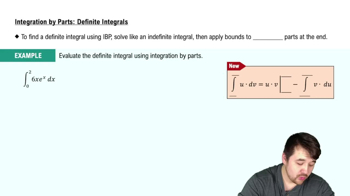
Integration by Parts for Definite Integrals

Inverse Trigonometric Functions

Inverse trigonometric functions, such as arctan (tan⁻¹), are functions that return the angle whose tangent is a given number. These functions are crucial in calculus, especially in integration, as they often appear in integrals involving rational functions. Understanding their properties and derivatives is essential for manipulating and solving integrals that include these functions.
Video consigliato:
06:35
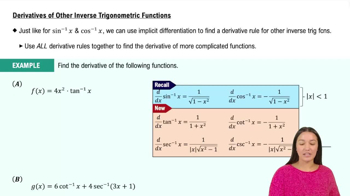
Derivatives of Other Inverse Trigonometric Functions

Differentiation of Composite Functions

The differentiation of composite functions, often referred to as the chain rule, is a key concept in calculus that allows us to differentiate functions that are composed of other functions. This is particularly important when dealing with integrals that involve products of functions, such as the one in the given question. Mastery of the chain rule aids in simplifying and solving integrals effectively.
Video consigliato:
3:48
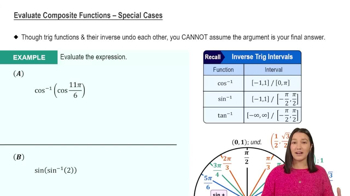
Evaluate Composite Functions - Special Cases
Pratica correlata
Domanda del libro di testo

Area functions and the Fundamental Theorem Consider the function

ƒ(t) = { t      if  ―2 ≤ t < 0

t²/2    if    0 ≤ t ≤ 2

and its graph shown below. Let F(𝓍) = ∫₋₁ˣ ƒ(t) dt and G(𝓍) = ∫₋₂ˣ ƒ(t) dt.                                                                                                               


(a) Evaluate F(―2) and F(2).

94
views

Domanda del libro di testo

Evaluating integrals Evaluate the following integrals.


∫₀² (2𝓍 + 1)³ d𝓍

109
views
Domanda del libro di testo

Limits with integrals Evaluate the following limits.


lim ∫₂ˣ eᵗ² dt

𝓍→2 ---------------

𝓍 ― 2

62
views
Domanda del libro di testo

Integration by Riemann sums Consider the integral ∫₁⁴ (3𝓍― 2) d𝓍.


(a) Evaluate the right Riemann sum for the integral with n = 3 .

85
views
Domanda del libro di testo

Evaluating integrals Evaluate the following integrals.


∫₁ᵉ d𝓍 / [𝓍(1 + ln 𝓍)]

82
views
Domanda del libro di testo

Explain why or why not Determine whether the following statements are true and give an explanation or counterexample. Assume ƒ and ƒ' are continuous functions for all real numbers.

(f) ∫ₐᵇ (2 ƒ(𝓍) ―3g (𝓍)) d𝓍 = 2 ∫ₐᵇ ƒ(𝓍) d𝓍 + 3 ∫₆ᵃ g(𝓍) d𝓍 .

37
views