Ch. 5 - Integration
Briggs - Calculus: Early Transcendentals 3rd Edition
Briggs3rd EditionCalculus: Early TranscendentalsISBN: 9780136847243Non è quello che usi tu?Cambia libro di testo
Capitolo 5, Problema 5.3.13d

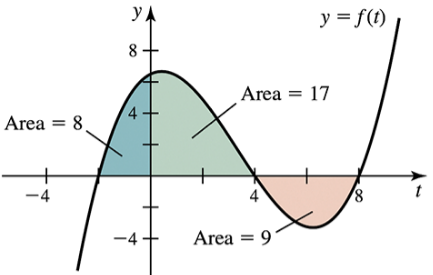
Area functions The graph of ƒ is shown in the figure. Let A(x) = ∫₋₂ˣ ƒ(t) dt and F(x) = ∫₄ˣ ƒ(t) dt be two area functions for ƒ. Evaluate the following area functions.
(d) F(4)
Graph of a function with labeled areas: 8, 9, and 17, illustrating integral calculations over specified intervals.

Guida verificata passo dopo passo
1
Step 1: Understand the problem. We are tasked with evaluating F(4), where F(x) = ∫₄ˣ ƒ(t) dt. This represents the net area under the curve of ƒ(t) from t = 4 to t = x. Specifically, F(4) means evaluating the integral from t = 4 to t = 4.
Step 2: Recall a key property of definite integrals. When the upper and lower limits of integration are the same, the integral evaluates to 0. Mathematically, ∫ₐₐ ƒ(t) dt = 0 for any function ƒ(t).
Step 3: Apply this property to the given integral. Since F(4) = ∫₄⁴ ƒ(t) dt, the integral evaluates to 0 because the interval of integration has no width.
Step 4: Confirm the reasoning using the graph. The graph shows areas labeled for different intervals, but since the interval from t = 4 to t = 4 has no length, no area is enclosed.
Step 5: Conclude that F(4) = 0 based on the mathematical property of definite integrals and the interpretation of the graph.

Risposta video verificata per un problema simile:

Questa soluzione video è stata consigliata dai nostri tutor come utile per risolvere questo problema.
Durata del video:
2m

Concetti chiave

Ecco i concetti essenziali che devi comprendere per rispondere correttamente alla domanda.

Definite Integral

A definite integral represents the signed area under a curve between two points on the x-axis. It is calculated using the Fundamental Theorem of Calculus, which connects differentiation and integration. In this context, the area functions A(x) and F(x) are defined as definite integrals, allowing us to evaluate the total area under the curve of the function f(t) from a specified lower limit to an upper limit.
Video consigliato:
Percorso guidato
05:43
Definition of the Definite Integral

Area Function

An area function, such as A(x) or F(x), is a function that gives the accumulated area under a curve from a specific starting point to a variable endpoint x. For example, A(x) = ∫₋₂ˣ f(t) dt calculates the area from -2 to x, while F(x) = ∫₄ˣ f(t) dt calculates the area from 4 to x. These functions help in understanding how the area changes as x varies.
Video consigliato:
05:06
Finding Area When Bounds Are Not Given

Evaluating Area Functions

To evaluate an area function at a specific point, such as F(4), one must compute the definite integral from the lower limit to the specified upper limit. In this case, F(4) = ∫₄⁴ f(t) dt, which represents the area under the curve from 4 to 4. Since the limits are the same, the result is zero, indicating no area is accumulated over that interval.
Video consigliato:
Percorso guidato
4:26
Evaluating Composed Functions
Pratica correlata
Domanda del libro di testo

Use Table 5.6 to evaluate the following indefinite integrals.                                                                                                               


 (e) ∫ d𝓍/(81 + 9𝓍²) (Hint: Factor a 9 out of the denominator first.)  

57
views

Domanda del libro di testo

Left and right Riemann sums Complete the following steps for the given function, interval, and value of n.

f(x) = x + 1 on [0,4]; n = 4

(d) Calculate the left and right Riemann sums.                                                                                                                                                

171
views
Domanda del libro di testo

Midpoint Riemann sums Complete the following steps for the given function, interval, and value of n.


ƒ(𝓍) = 2x + 1 on [0,4] ; n = 4


d) Calculate the midpoint Riemann sum.

162
views
Domanda del libro di testo

Sigma notation Evaluate the following expressions.                                                                                                                                          

(e)     3                                                                                                                                                                               

       ∑  (2m + 2) / 3                                                                                                                                                                          

      m =1                         

79
views
Domanda del libro di testo

{Use of Tech} Approximating definite integrals Complete the following steps for the given integral and the given value of n. 

(d) Determine which Riemann sum (left or right) underestimates the value of the definite integral and which overestimates the value of the definite integral.


∫₀^π/2 cos 𝓍 d𝓍 ; n = 4

80
views
Domanda del libro di testo

Use Table 5.6 to evaluate the following indefinite integrals.                                                                                                               


 (f) ∫ d𝓍/√36 ―𝓍²

78
views