Ch. 5 - Integration
Briggs - Calculus: Early Transcendentals 3rd Edition
Briggs3rd EditionCalculus: Early TranscendentalsISBN: 9780136847243Non è quello che usi tu?Cambia libro di testo
Capitolo 5, Problema 5.2.34d

{Use of Tech} Approximating definite integrals Complete the following steps for the given integral and the given value of n. 
(d) Determine which Riemann sum (left or right) underestimates the value of the definite integral and which overestimates the value of the definite integral.


∫₀^π/2 cos 𝓍 d𝓍 ; n = 4

Guida verificata passo dopo passo
1
Step 1: Understand the problem. The goal is to approximate the definite integral ∫₀^(π/2) cos(𝓍) d𝓍 using Riemann sums with n = 4 subintervals. Additionally, determine which Riemann sum (left or right) underestimates or overestimates the integral.
Step 2: Divide the interval [0, π/2] into n = 4 equal subintervals. The width of each subinterval, Δ𝓍, is calculated as Δ𝓍 = (b - a) / n, where a = 0 and b = π/2.
Step 3: For the left Riemann sum, use the left endpoints of each subinterval to evaluate the function cos(𝓍). The left Riemann sum is given by the formula: S_left = Δ𝓍 * Σ[f(x_i)], where x_i are the left endpoints of the subintervals.
Step 4: For the right Riemann sum, use the right endpoints of each subinterval to evaluate the function cos(𝓍). The right Riemann sum is given by the formula: S_right = Δ𝓍 * Σ[f(x_i)], where x_i are the right endpoints of the subintervals.
Step 5: Analyze the behavior of the function cos(𝓍) on the interval [0, π/2]. Since cos(𝓍) is decreasing on this interval, the left Riemann sum will overestimate the integral (as it uses higher values of the function at the left endpoints), while the right Riemann sum will underestimate the integral (as it uses lower values of the function at the right endpoints).

Risposta video verificata per un problema simile:

Questa soluzione video è stata consigliata dai nostri tutor come utile per risolvere questo problema.
Durata del video:
1m

Concetti chiave

Ecco i concetti essenziali che devi comprendere per rispondere correttamente alla domanda.

Riemann Sums

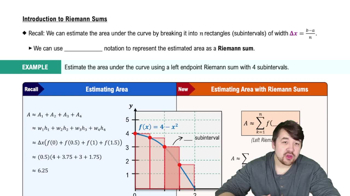
Riemann sums are a method for approximating the value of a definite integral by dividing the area under a curve into smaller rectangles. The sum of the areas of these rectangles provides an estimate of the integral's value. Depending on whether the left or right endpoints of the subintervals are used, the Riemann sum can either overestimate or underestimate the actual area, which is crucial for understanding the behavior of the integral.
Video consigliato:
Percorso guidato
06:11
Introduction to Riemann Sums

Definite Integrals

A definite integral represents the net area under a curve between two specified limits, in this case, from 0 to π/2 for the function cos(x). It is calculated using the Fundamental Theorem of Calculus, which connects differentiation and integration. Understanding definite integrals is essential for evaluating the total accumulation of quantities, such as area, over an interval.
Video consigliato:
Percorso guidato
05:43
Definition of the Definite Integral

Overestimation and Underestimation

In the context of Riemann sums, overestimation occurs when the sum of the areas of the rectangles exceeds the actual area under the curve, while underestimation occurs when the sum falls short. For a decreasing function like cos(x) on the interval [0, π/2], the left Riemann sum will overestimate the integral, and the right Riemann sum will underestimate it. Recognizing these patterns is vital for accurately interpreting the results of numerical integration.
Video consigliato:
Percorso guidato
10:22
Left, Right, & Midpoint Riemann Sums Example 1
Pratica correlata
Domanda del libro di testo

Use Table 5.6 to evaluate the following indefinite integrals.                                                                                                               


 (e) ∫ d𝓍/(81 + 9𝓍²) (Hint: Factor a 9 out of the denominator first.)  

57
views

Domanda del libro di testo

Left and right Riemann sums Complete the following steps for the given function, interval, and value of n.

f(x) = x + 1 on [0,4]; n = 4

(d) Calculate the left and right Riemann sums.                                                                                                                                                

171
views
Domanda del libro di testo

Properties of integrals Consider two functions ƒ and g on [1,6] such that ∫₁⁶ƒ(𝓍) d𝓍 = 10 and ∫₁⁶g(𝓍) d𝓍 = 5, ∫₄⁶ƒ(𝓍) d𝓍 = 5 , and ∫₁⁴g(𝓍) d𝓍 = 2. Evaluate the following integrals.


(d) ∫₄⁶ (g(𝓍) ― f(𝓍) d𝓍

80
views
Domanda del libro di testo

Midpoint Riemann sums Complete the following steps for the given function, interval, and value of n.


ƒ(𝓍) = 2x + 1 on [0,4] ; n = 4


d) Calculate the midpoint Riemann sum.

162
views
Domanda del libro di testo

Sigma notation Evaluate the following expressions.                                                                                                                                          

(e)     3                                                                                                                                                                               

       ∑  (2m + 2) / 3                                                                                                                                                                          

      m =1                         

79
views
Domanda del libro di testo

Area functions The graph of ƒ is shown in the figure. Let A(x) = ∫₋₂ˣ ƒ(t) dt and F(x) = ∫₄ˣ ƒ(t) dt be two area functions for ƒ. Evaluate the following area functions.

(d) F(4)

51
views