Ch. 5 - Integration
Briggs - Calculus: Early Transcendentals 3rd Edition
Briggs3rd EditionCalculus: Early TranscendentalsISBN: 9780136847243Non è quello che usi tu?Cambia libro di testo
Capitolo 5, Problema 5.R.45

Evaluating integrals Evaluate the following integrals.


∫π/₆^π/³ (sec² t + csc² t) dt

Guida verificata passo dopo passo
1
Step 1: Recognize that the integral involves the sum of two trigonometric functions: sec²(t) and csc²(t). Recall their respective antiderivatives: ∫sec²(t) dt = tan(t) and ∫csc²(t) dt = -cot(t).
Step 2: Break the integral into two separate integrals: ∫(sec²(t) + csc²(t)) dt = ∫sec²(t) dt + ∫csc²(t) dt.
Step 3: Compute the antiderivative of each term. For sec²(t), the antiderivative is tan(t). For csc²(t), the antiderivative is -cot(t). Combine these results to get tan(t) - cot(t).
Step 4: Apply the Fundamental Theorem of Calculus to evaluate the definite integral. Substitute the upper limit π/3 and the lower limit π/6 into the antiderivative expression tan(t) - cot(t).
Step 5: Simplify the result by calculating tan(π/3), tan(π/6), cot(π/3), and cot(π/6). Subtract the values obtained at the lower limit from those at the upper limit to find the final value of the integral.

Risposta video verificata per un problema simile:

Questa soluzione video è stata consigliata dai nostri tutor come utile per risolvere questo problema.
Durata del video:
3m

Concetti chiave

Ecco i concetti essenziali che devi comprendere per rispondere correttamente alla domanda.

Integration

Integration is a fundamental concept in calculus that involves finding the accumulated area under a curve represented by a function. It is the reverse process of differentiation and is used to calculate quantities such as areas, volumes, and total accumulated change. The integral symbol (∫) denotes the operation, and definite integrals, like the one in the question, have specified limits of integration.
Video consigliato:
Percorso guidato
06:18
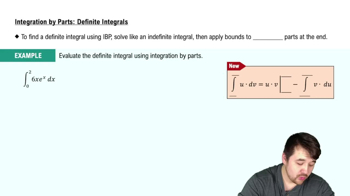
Integration by Parts for Definite Integrals

Trigonometric Functions

Trigonometric functions, such as secant (sec) and cosecant (csc), are essential in calculus, particularly in integrals involving angles. The secant function is defined as the reciprocal of the cosine function, while the cosecant function is the reciprocal of the sine function. Understanding their properties and relationships is crucial for evaluating integrals that include these functions.
Video consigliato:
Percorso guidato
6:04
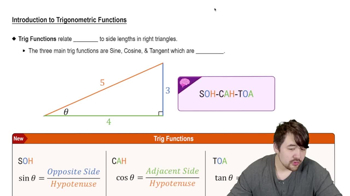
Introduction to Trigonometric Functions

Fundamental Theorem of Calculus

The Fundamental Theorem of Calculus links the concept of differentiation with integration, stating that if a function is continuous on an interval, then the integral of its derivative over that interval equals the change in the function's values at the endpoints. This theorem allows us to evaluate definite integrals by finding an antiderivative of the integrand and applying the limits of integration, simplifying the process of calculating areas under curves.
Video consigliato:
Percorso guidato
06:11
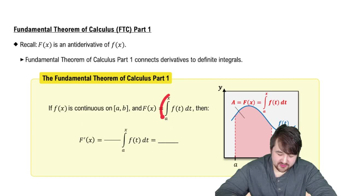
Fundamental Theorem of Calculus Part 1
Pratica correlata
Domanda del libro di testo

Area versus net area Find (i) the net area and (ii) the area of the region bounded by the graph of ƒ and the 𝓍-axis on the given interval. You may find it useful to sketch the region.

ƒ(𝓍) = 𝓍⁴ ― 𝓍² on [―1, 1]

152
views

Domanda del libro di testo

Find the average value of ƒ(𝓍) = e²ˣ on [0, ln 2] .

53
views
Domanda del libro di testo

Evaluate the following derivatives.


d/d𝓍 ∫₃ᵉˣ cos t² dt

98
views
Domanda del libro di testo

Geometry of integrals Without evaluating the integrals, explain why the following statement is true for positive integers n:

∫₀¹ 𝓍ⁿd𝓍 + ∫₀¹ ⁿ√(𝓍d𝓍) = 1

70
views
Domanda del libro di testo

Area of regions Compute the area of the region bounded by the graph of ƒ and the 𝓍-axis on the given interval. You may find it useful to sketch the region.                                              


 ƒ(𝓍) = 2 sin 𝓍/4 on [0, 2π]

103
views
Domanda del libro di testo

Properties of integrals Suppose ∫₁⁴ ƒ(𝓍) d𝓍 = 6 , ∫₁⁴ g(𝓍) d𝓍 = 4 and ∫₃⁴ ƒ(𝓍) d𝓍 = 2 . Evaluate the following integrals or state that there is not enough information.


∫₁³ ƒ(𝓍)/g(𝓍) d𝓍

42
views