Ch. 5 - Integration
Briggs - Calculus: Early Transcendentals 3rd Edition
Briggs3rd EditionCalculus: Early TranscendentalsISBN: 9780136847243Non è quello che usi tu?Cambia libro di testo
Capitolo 5, Problema 5.R.30

Evaluate the following derivatives.


d/d𝓍 ∫₃ᵉˣ cos t² dt

Guida verificata passo dopo passo
1
Step 1: Recognize that the problem involves differentiating an integral with variable limits. This is a classic application of the Leibniz rule for differentiation under the integral sign.
Step 2: Recall the Fundamental Theorem of Calculus, which states that if you have an integral of the form ∫ₐᵇ f(t) dt, where the limits of integration are functions of x, the derivative with respect to x is given by: d/d𝓍 ∫ₐᵇ f(t) dt = f(b) * (db/d𝓍) - f(a) * (da/d𝓍).
Step 3: Identify the limits of integration in the given problem. The lower limit is a constant (3), and the upper limit is eˣ, which is a function of x. This means da/d𝓍 = 0 and db/d𝓍 = d/d𝓍(eˣ) = eˣ.
Step 4: Substitute the limits into the formula. The derivative becomes: cos((eˣ)²) * eˣ - cos(3²) * 0. Note that the second term vanishes because the derivative of a constant lower limit is zero.
Step 5: Simplify the expression. The final derivative is cos((eˣ)²) * eˣ. This is the result after applying the Leibniz rule and simplifying.

Risposta video verificata per un problema simile:

Questa soluzione video è stata consigliata dai nostri tutor come utile per risolvere questo problema.
Durata del video:
2m

Concetti chiave

Ecco i concetti essenziali che devi comprendere per rispondere correttamente alla domanda.

Fundamental Theorem of Calculus

The Fundamental Theorem of Calculus links differentiation and integration, stating that if F is an antiderivative of f on an interval [a, b], then the integral of f from a to b can be computed using F. This theorem allows us to evaluate the derivative of an integral function, which is essential for solving the given problem.
Video consigliato:
Percorso guidato
06:11
Fundamental Theorem of Calculus Part 1

Differentiation Under the Integral Sign

Differentiation under the integral sign is a technique that allows us to differentiate an integral with respect to a parameter. In this case, we differentiate the integral of cos(t²) with respect to x, treating the limits of integration as constants. This method is crucial for evaluating the derivative of the given integral expression.
Video consigliato:
Percorso guidato
05:53
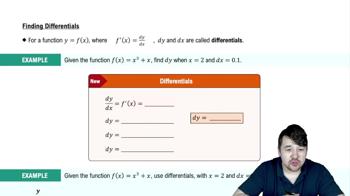
Finding Differentials

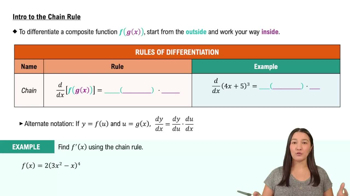
Chain Rule

The Chain Rule is a fundamental principle in calculus used to differentiate composite functions. When applying the Chain Rule, we differentiate the outer function and multiply it by the derivative of the inner function. In the context of the given problem, it helps in evaluating the derivative of the integral with respect to x, especially when the limits of integration are functions of x.
Video consigliato:
05:02
Intro to the Chain Rule
Pratica correlata
Domanda del libro di testo

Evaluating integrals Evaluate the following integrals.


∫₀^²π cos² 𝓍/6 d𝓍

56
views

Domanda del libro di testo

Explain why or why not Determine whether the following statements are true and give an explanation or counterexample. Assume ƒ and ƒ' are continuous functions for all real numbers.

(a) A(𝓍) = ∫ₐˣ ƒ(t) dt and ƒ(t) = 2t―3 , then A is a quadratic function.

46
views
Domanda del libro di testo

Evaluating integrals Evaluate the following integrals.


∫π/₆^π/³ (sec² t + csc² t) dt

63
views
Domanda del libro di testo

Evaluating integrals Evaluate the following integrals.


∫₀¹ √𝓍 (√𝓍 + 1) d𝓍

72
views
Domanda del libro di testo

Geometry of integrals Without evaluating the integrals, explain why the following statement is true for positive integers n:

∫₀¹ 𝓍ⁿd𝓍 + ∫₀¹ ⁿ√(𝓍d𝓍) = 1

70
views
Domanda del libro di testo

Area of regions Compute the area of the region bounded by the graph of ƒ and the 𝓍-axis on the given interval. You may find it useful to sketch the region.                                              


 ƒ(𝓍) = 2 sin 𝓍/4 on [0, 2π]

103
views