Ch. 5 - Integration
Briggs - Calculus: Early Transcendentals 3rd Edition
Briggs3rd EditionCalculus: Early TranscendentalsISBN: 9780136847243Non è quello che usi tu?Cambia libro di testo
Capitolo 5, Problema 5.R.1a

Explain why or why not Determine whether the following statements are true and give an explanation or counterexample. Assume ƒ and ƒ' are continuous functions for all real numbers.
(a) A(𝓍) = ∫ₐˣ ƒ(t) dt and ƒ(t) = 2t―3 , then A is a quadratic function.

Guida verificata passo dopo passo
1
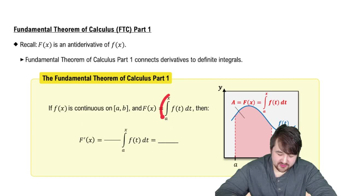
Step 1: Begin by recalling the Fundamental Theorem of Calculus, which states that if A(𝓍) = ∫ₐˣ ƒ(t) dt, then A'(𝓍) = ƒ(𝓍). This means the derivative of A(𝓍) is equal to the function ƒ(𝓍).
Step 2: Analyze the given function ƒ(t) = 2t - 3. This is a linear function because it is in the form of a first-degree polynomial (ax + b).
Step 3: Integrate ƒ(t) = 2t - 3 with respect to t to find A(𝓍). The integral of 2t is t², and the integral of -3 is -3t. Therefore, A(𝓍) = t² - 3t + C, where C is the constant of integration.
Step 4: Observe that A(𝓍) = t² - 3t + C is a quadratic function because it is in the form of a second-degree polynomial (ax² + bx + c). Quadratic functions are characterized by the presence of a squared term.
Step 5: Conclude that the statement is true because the integration of the linear function ƒ(t) = 2t - 3 results in a quadratic function A(𝓍). The explanation is based on the properties of integration and the structure of the resulting polynomial.

Risposta video verificata per un problema simile:

Questa soluzione video è stata consigliata dai nostri tutor come utile per risolvere questo problema.
Durata del video:
2m

Concetti chiave

Ecco i concetti essenziali che devi comprendere per rispondere correttamente alla domanda.

Fundamental Theorem of Calculus

The Fundamental Theorem of Calculus links the concept of differentiation and integration, stating that if a function is continuous on an interval, then the integral of its derivative over that interval gives the net change of the function. This theorem allows us to evaluate definite integrals and understand the relationship between a function and its antiderivative.
Video consigliato:
Percorso guidato
06:11
Fundamental Theorem of Calculus Part 1

Definite Integral

A definite integral represents the accumulation of quantities, such as area under a curve, over a specific interval. It is denoted as ∫ₐˣ ƒ(t) dt, where 'a' and 'x' are the limits of integration. The result of a definite integral is a number that quantifies the total accumulation of the function ƒ(t) from 'a' to 'x'.
Video consigliato:
Percorso guidato
05:43
Definition of the Definite Integral

Quadratic Functions

A quadratic function is a polynomial function of degree two, typically expressed in the form f(x) = ax² + bx + c, where a, b, and c are constants and a ≠ 0. The graph of a quadratic function is a parabola, which can open upwards or downwards depending on the sign of 'a'. Understanding the properties of quadratic functions is essential for determining the nature of the function A(x) in the given problem.
Video consigliato:
Percorso guidato
13:42
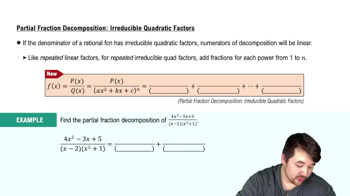
Partial Fraction Decomposition: Irreducible Quadratic Factors