

Ch. 5 - Integration
Briggs - Calculus: Early Transcendentals 3rd Edition
Briggs3rd EditionCalculus: Early TranscendentalsISBN: 9780136847243Non è quello che usi tu?Cambia libro di testo
Capitolo 5, Problema 5.R.1c

Explain why or why not Determine whether the following statements are true and give an explanation or counterexample. Assume ƒ and ƒ' are continuous functions for all real numbers.
(c) ∫ₐᵇ ƒ'(𝓍) d𝓍 = ƒ(b) ―ƒ(a) .

Guida verificata passo dopo passo
1
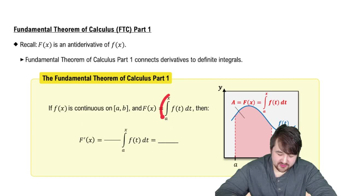
Step 1: Recall the Fundamental Theorem of Calculus, Part 1, which states that if a function ƒ is continuous on [a, b] and has a derivative ƒ'(𝓍), then the definite integral of ƒ'(𝓍) from a to b is equal to ƒ(b) - ƒ(a).
Step 2: Analyze the given statement ∫ₐᵇ ƒ'(𝓍) d𝓍 = ƒ(b) ― ƒ(a). This matches the conclusion of the Fundamental Theorem of Calculus, Part 1.
Step 3: Verify the conditions for applying the theorem. The problem states that ƒ and ƒ' are continuous functions for all real numbers, which satisfies the requirement for the theorem to hold.
Step 4: Conclude that the statement is true because it directly follows from the Fundamental Theorem of Calculus, given the continuity of ƒ and ƒ'.
Step 5: If needed, provide a counterexample to test the validity of the statement. For instance, if ƒ or ƒ' were not continuous, the theorem would not apply, and the statement could be false. However, in this case, the conditions are met, so the statement is true.

Risposta video verificata per un problema simile:

Questa soluzione video è stata consigliata dai nostri tutor come utile per risolvere questo problema.
Durata del video:
1m

Concetti chiave

Ecco i concetti essenziali che devi comprendere per rispondere correttamente alla domanda.

Fundamental Theorem of Calculus

The Fundamental Theorem of Calculus connects differentiation and integration, stating that if a function is continuous on an interval [a, b], then the integral of its derivative over that interval equals the difference in the function's values at the endpoints. Specifically, it asserts that ∫ₐᵇ ƒ'(𝓍) d𝓍 = ƒ(b) - ƒ(a), which is crucial for evaluating the given statement.
Video consigliato:
Percorso guidato
06:11
Fundamental Theorem of Calculus Part 1

Continuous Functions

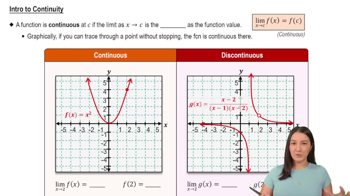
A function is continuous if there are no breaks, jumps, or holes in its graph over its domain. For the Fundamental Theorem of Calculus to hold, both the function ƒ and its derivative ƒ' must be continuous on the interval [a, b]. This ensures that the integral can be computed reliably and that the function behaves predictably across the interval.
Video consigliato:
05:34
Intro to Continuity

Definite Integral

A definite integral represents the signed area under the curve of a function between two points, a and b. It is denoted as ∫ₐᵇ ƒ(𝓍) d𝓍 and provides a way to calculate the accumulation of quantities. In the context of the question, understanding the properties of definite integrals is essential for verifying the truth of the statement regarding the relationship between the integral of a derivative and the values of the original function.
Video consigliato:
Percorso guidato
05:43
Definition of the Definite Integral
Pratica correlata
Domanda del libro di testo

Limit definition of the definite integral Use the limit definition of the definite integral with right Riemann sums and a regular partition to evaluate the following definite integrals. Use the Fundamental Theorem of Calculus to check your answer. 


∫₀⁴ (𝓍³―𝓍) d𝓍

96
views
Domanda del libro di testo

Definite integrals Evaluate the following integrals using the Fundamental Theorem of Calculus


∫₁⁸ 8𝓍¹/³ d𝓍

77
views
Domanda del libro di testo

Definite integrals Evaluate the following integrals using the Fundamental Theorem of Calculus. Explain why your result is consistent with the figure.


∫₀¹ (𝓍² ― 2𝓍 + 3) d𝓍


132
views
Domanda del libro di testo

Explain why or why not Determine whether the following statements are true and give an explanation or counterexample. Assume ƒ and ƒ' are continuous functions for all real numbers.

(d) If ƒ is continuous on [a,b] and ∫ₐᵇ |ƒ(𝓍)| d𝓍 = 0 , then ƒ(𝓍) = 0 on [a,b] .

64
views
Domanda del libro di testo

Displacement from velocity A particle moves along a line with a velocity given by v(t) = 5 sin πt, starting with an initial position s(0) = 0 . Find the displacement of the particle between t = 0 and t = 2 , which is given by s(t) = ∫₀² v(t) dt . Find the distance traveled by the particle during this interval, which is ∫₀² |v(t)| dt .

194
views
Domanda del libro di testo

Velocity to displacement An object travels on the 𝓍-axis with a velocity given by v(t) = 2t + 5, for 0 ≤ t ≤ 4.


(c) True or false: The object would travel as far as in part (a) if it traveled at its average velocity (a constant), for 0 ≤ t ≤ 4. .

80
views