Ch. 5 - Integration
Briggs - Calculus: Early Transcendentals 3rd Edition
Briggs3rd EditionCalculus: Early TranscendentalsISBN: 9780136847243Non è quello che usi tu?Cambia libro di testo
Capitolo 5, Problema 5.R.13

Limit definition of the definite integral Use the limit definition of the definite integral with right Riemann sums and a regular partition to evaluate the following definite integrals. Use the Fundamental Theorem of Calculus to check your answer. 


∫₀⁴ (𝓍³―𝓍) d𝓍

Guida verificata passo dopo passo
1
Step 1: Recall the limit definition of the definite integral. The definite integral ∫ₐᵇ f(𝓍) d𝓍 can be approximated using right Riemann sums with a regular partition. Divide the interval [a, b] into n subintervals of equal width Δ𝓍 = (b - a)/n.
Step 2: For the given integral ∫₀⁴ (𝓍³ - 𝓍) d𝓍, the interval [0, 4] is divided into n subintervals. The width of each subinterval is Δ𝓍 = (4 - 0)/n = 4/n.
Step 3: The right endpoints of the subintervals are given by 𝓍ᵢ = a + iΔ𝓍 = 0 + i(4/n) = (4i)/n, where i ranges from 1 to n.
Step 4: Substitute the function f(𝓍) = 𝓍³ - 𝓍 into the Riemann sum formula. The sum becomes Sₙ = Σᵢ₌₁ⁿ f(𝓍ᵢ)Δ𝓍 = Σᵢ₌₁ⁿ [(𝓍ᵢ³ - 𝓍ᵢ) * Δ𝓍]. Replace 𝓍ᵢ with (4i)/n and Δ𝓍 with 4/n.
Step 5: Simplify the expression for Sₙ: Sₙ = Σᵢ₌₁ⁿ [((4i)/n)³ - (4i)/n] * (4/n). Expand and simplify the terms inside the summation. Then, take the limit as n → ∞ to compute the exact value of the integral. Finally, use the Fundamental Theorem of Calculus to verify the result by directly evaluating ∫₀⁴ (𝓍³ - 𝓍) d𝓍.

Risposta video verificata per un problema simile:

Questa soluzione video è stata consigliata dai nostri tutor come utile per risolvere questo problema.
Durata del video:
6m

Concetti chiave

Ecco i concetti essenziali che devi comprendere per rispondere correttamente alla domanda.

Definite Integral

A definite integral represents the signed area under a curve defined by a function over a specific interval. It is calculated as the limit of Riemann sums, which approximate the area by dividing the interval into smaller subintervals and summing the areas of rectangles formed. The notation ∫ₐᵇ f(x) dx indicates the integral of f(x) from a to b.
Video consigliato:
Percorso guidato
05:43
Definition of the Definite Integral

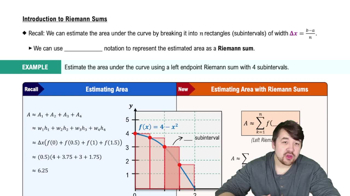
Riemann Sums

Riemann sums are a method for approximating the value of a definite integral by dividing the area under a curve into rectangles. The height of each rectangle is determined by the function's value at specific points within each subinterval, such as the right endpoint, left endpoint, or midpoint. As the number of rectangles increases (and their width decreases), the Riemann sum approaches the exact value of the definite integral.
Video consigliato:
Percorso guidato
06:11
Introduction to Riemann Sums

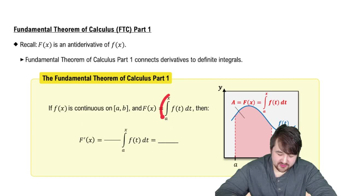
Fundamental Theorem of Calculus

The Fundamental Theorem of Calculus links differentiation and integration, stating that if F is an antiderivative of f on an interval [a, b], then the definite integral of f from a to b can be computed as F(b) - F(a). This theorem provides a powerful way to evaluate definite integrals by finding an antiderivative rather than relying solely on Riemann sums.
Video consigliato:
Percorso guidato
06:11
Fundamental Theorem of Calculus Part 1