Ch. 5 - Integration
Briggs - Calculus: Early Transcendentals 3rd Edition
Briggs3rd EditionCalculus: Early TranscendentalsISBN: 9780136847243Non è quello che usi tu?Cambia libro di testo
Capitolo 5, Problema 5.1.59a

Explain why or why not Determine whether the following statements are true and give an explanation or counterexample.
(a) Consider the linear function ƒ(𝓍) = 2x + 5 and the region bounded by its graph and the x-axis on the interval [3,6]. Suppose the area of this region is approximated using midpoint Riemann sums. Then the approximations give the exact area of the region for any number of subintervals.

Guida verificata passo dopo passo
1
Step 1: Understand the problem. The question asks whether midpoint Riemann sums give the exact area of the region bounded by the graph of the linear function ƒ(𝓍) = 2𝓍 + 5 and the x-axis on the interval [3,6], regardless of the number of subintervals used.
Step 2: Recall the definition of midpoint Riemann sums. Midpoint Riemann sums approximate the area under a curve by dividing the interval into subintervals, calculating the function value at the midpoint of each subinterval, and summing the areas of the rectangles formed.
Step 3: Consider the properties of linear functions. Linear functions, such as ƒ(𝓍) = 2𝓍 + 5, are straight lines. The area under a linear function on a closed interval can be calculated exactly using geometry (e.g., the area of a trapezoid) or integration.
Step 4: Analyze the midpoint Riemann sum for linear functions. For linear functions, the midpoint Riemann sum provides the exact area under the curve because the function's rate of change is constant, and the midpoints perfectly capture the average height of the function over each subinterval.
Step 5: Conclude the reasoning. Since the function ƒ(𝓍) = 2𝓍 + 5 is linear, the midpoint Riemann sum will always give the exact area of the region bounded by the graph and the x-axis on the interval [3,6], regardless of the number of subintervals used.

Risposta video verificata per un problema simile:

Questa soluzione video è stata consigliata dai nostri tutor come utile per risolvere questo problema.
Durata del video:
1m

Concetti chiave

Ecco i concetti essenziali che devi comprendere per rispondere correttamente alla domanda.

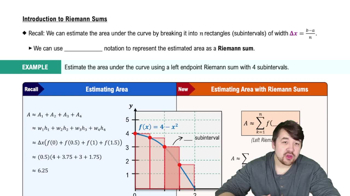
Riemann Sums

Riemann sums are a method for approximating the area under a curve by dividing the region into subintervals and summing the areas of rectangles formed. The height of each rectangle is determined by the function's value at specific points within the subintervals, such as the left endpoint, right endpoint, or midpoint. The accuracy of the approximation improves as the number of subintervals increases, but it may not always yield the exact area unless certain conditions are met.
Video consigliato:
Percorso guidato
06:11
Introduction to Riemann Sums

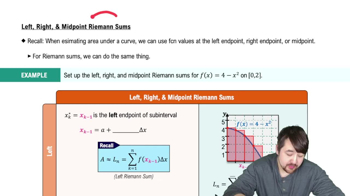
Midpoint Riemann Sum

A midpoint Riemann sum specifically uses the midpoint of each subinterval to determine the height of the rectangles. This method can provide a better approximation of the area under the curve compared to using left or right endpoints, especially for functions that are not linear. However, for linear functions, like ƒ(𝓍) = 2x + 5, the midpoint Riemann sum will yield the exact area regardless of the number of subintervals used.
Video consigliato:
Percorso guidato
07:39
Left, Right, & Midpoint Riemann Sums

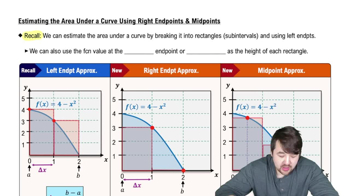
Area Under a Curve

The area under a curve represents the integral of a function over a specified interval. For linear functions, the area can be calculated using geometric formulas, such as the area of a trapezoid or triangle, since the graph forms straight lines. In the case of the function ƒ(𝓍) = 2x + 5, the area between the graph and the x-axis on the interval [3,6] can be computed directly, confirming that Riemann sums will yield the exact area due to the linearity of the function.
Video consigliato:
Percorso guidato
05:59
Estimating the Area Under a Curve with Right Endpoints & Midpoint