Ch. 5 - Integration
Briggs - Calculus: Early Transcendentals 3rd Edition
Briggs3rd EditionCalculus: Early TranscendentalsISBN: 9780136847243Non è quello che usi tu?Cambia libro di testo
Capitolo 5, Problema 5.RE.15c

Symmetry properties Suppose ∫₀⁴ ƒ(𝓍) d𝓍 = 10 and ∫₀⁴ g(𝓍) d𝓍 = 20. Furthermore, suppose ƒ is an even function and g is an odd function. Evaluate the following integrals.


(c) ∫₋₄⁴ (4ƒ(𝓍) ― 3g(𝓍))d𝓍

Guida verificata passo dopo passo
1
Step 1: Recall the symmetry properties of even and odd functions. An even function satisfies ƒ(𝓍) = ƒ(−𝓍), and its integral over a symmetric interval [−a, a] is twice the integral over [0, a]. An odd function satisfies g(𝓍) = −g(−𝓍), and its integral over a symmetric interval [−a, a] is 0.
Step 2: Break the given integral ∫₋₄⁴ (4ƒ(𝓍) ― 3g(𝓍)) d𝓍 into two separate integrals: ∫₋₄⁴ 4ƒ(𝓍) d𝓍 and ∫₋₄⁴ −3g(𝓍) d𝓍. This uses the linearity property of integrals.
Step 3: For the first term, ∫₋₄⁴ 4ƒ(𝓍) d𝓍, note that ƒ(𝓍) is an even function. Therefore, ∫₋₄⁴ ƒ(𝓍) d𝓍 = 2∫₀⁴ ƒ(𝓍) d𝓍. Multiply this result by 4 to account for the coefficient.
Step 4: For the second term, ∫₋₄⁴ −3g(𝓍) d𝓍, note that g(𝓍) is an odd function. The integral of an odd function over a symmetric interval [−a, a] is 0. Therefore, this term evaluates to 0.
Step 5: Combine the results from Step 3 and Step 4. The final integral ∫₋₄⁴ (4ƒ(𝓍) ― 3g(𝓍)) d𝓍 simplifies to the result obtained from the first term, as the second term is 0.

Risposta video verificata per un problema simile:

Questa soluzione video è stata consigliata dai nostri tutor come utile per risolvere questo problema.
Durata del video:
3m

Concetti chiave

Ecco i concetti essenziali che devi comprendere per rispondere correttamente alla domanda.

Even and Odd Functions

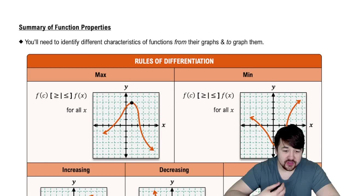
An even function satisfies the property f(-x) = f(x) for all x in its domain, meaning its graph is symmetric about the y-axis. Conversely, an odd function satisfies g(-x) = -g(x), indicating symmetry about the origin. These properties are crucial for evaluating integrals over symmetric intervals, as they allow simplifications based on the behavior of the functions.
Video consigliato:
Percorso guidato
06:21
Properties of Functions

Properties of Definite Integrals

Definite integrals have specific properties that can simplify calculations. For instance, the integral of an even function over a symmetric interval [-a, a] is twice the integral from 0 to a, while the integral of an odd function over the same interval is zero. These properties help in evaluating integrals without direct computation.
Video consigliato:
Percorso guidato
05:43
Definition of the Definite Integral

Linear Combination of Integrals

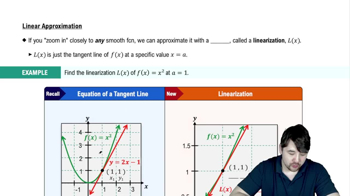
The linearity of integrals allows us to combine integrals of functions through addition and scalar multiplication. Specifically, ∫(af(x) + bg(x))dx = a∫f(x)dx + b∫g(x)dx, where a and b are constants. This property is essential for evaluating integrals involving multiple functions, as it enables the separation of terms for easier computation.
Video consigliato: