
Explain why or why not Determine whether the following statements are true and give an explanation or counterexample. Assume ƒ, ƒ', and ƒ'' are continuous functions for all real numbers.
(b) ∫ (ƒ(𝓍))ⁿ ƒ'(𝓍) d𝓍 = 1/(n + 1) (ƒ(𝓍))ⁿ⁺¹ + C , n ≠ ―1 .
Guida verificata passo dopo passo
Explain why or why not Determine whether the following statements are true and give an explanation or counterexample. Assume ƒ, ƒ', and ƒ'' are continuous functions for all real numbers.
(b) ∫ (ƒ(𝓍))ⁿ ƒ'(𝓍) d𝓍 = 1/(n + 1) (ƒ(𝓍))ⁿ⁺¹ + C , n ≠ ―1 .
Substitutions Suppose ƒ is an even function with ∫₀⁸ ƒ(𝓍) d𝓍 = 9 . Evaluate each integral.
(b) ∫²₋₂ 𝓍²ƒ(𝓍³) d𝓍
Explain why or why not Determine whether the following statements are true and give an explanation or counterexample.
(b) If ƒ is a linear function on the interval [a,b] , then a midpoint Riemann sums give the exact value of ∫ₐᵇ ƒ(𝓍) d𝓍, for any positive integer n.
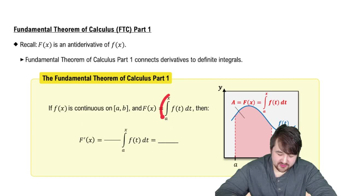
Working with area functions Consider the function ƒ and its graph.
(b) Estimate the points (if any) at which A has a local maximum or minimum.
Area functions for constant functions Consider the following functions ƒ and real numbers a (see figure).
(b) Verify that .A'(𝓍) = ƒ(𝓍)
ƒ(t) = 5 , a = -5
Explain why or why not Determine whether the following statements are true and give an explanation or counterexample.
(b) Suppose ƒ is a negative increasing function, for 𝓍 > 0 . Then the area function A(𝓍) = ∫₀ˣ ƒ(t) dt is a decreasing function of 𝓍 .