
Ch. 5 - Integration
Briggs - Calculus: Early Transcendentals 3rd Edition
Briggs3rd EditionCalculus: Early TranscendentalsISBN: 9780136847243Non è quello che usi tu?Cambia libro di testo
Capitolo 5, Problema 5.5.95b

Explain why or why not Determine whether the following statements are true and give an explanation or counterexample. Assume ƒ, ƒ', and ƒ'' are continuous functions for all real numbers.                                                                                                                                                           
                                                                                                                                                                    
(b) ∫ (ƒ(𝓍))ⁿ ƒ'(𝓍) d𝓍 = 1/(n + 1) (ƒ(𝓍))ⁿ⁺¹ + C , n ≠ ―1 .

Guida verificata passo dopo passo
1
Step 1: Recognize that the problem involves verifying the given integral formula. The formula states that the integral of (ƒ(𝓍))ⁿ multiplied by ƒ'(𝓍) with respect to 𝓍 equals 1/(n + 1) * (ƒ(𝓍))ⁿ⁺¹ + C, where n ≠ -1.
Step 2: Use substitution to simplify the integral. Let u = ƒ(𝓍). Then, du = ƒ'(𝓍) d𝓍. This substitution transforms the integral into ∫ uⁿ du.
Step 3: Recall the power rule for integration. The integral of uⁿ with respect to u is (1/(n + 1)) * uⁿ⁺¹ + C, provided n ≠ -1. This matches the structure of the given formula.
Step 4: Substitute back u = ƒ(𝓍) into the result of the integration. This gives (1/(n + 1)) * (ƒ(𝓍))ⁿ⁺¹ + C, which is consistent with the formula provided in the problem.
Step 5: Conclude that the formula is correct for n ≠ -1, as the derivation using substitution and the power rule confirms its validity. The condition n ≠ -1 ensures the denominator (n + 1) does not become zero, which would make the formula undefined.

Risposta video verificata per un problema simile:

Questa soluzione video è stata consigliata dai nostri tutor come utile per risolvere questo problema.
Durata del video:
2m

Concetti chiave

Ecco i concetti essenziali che devi comprendere per rispondere correttamente alla domanda.

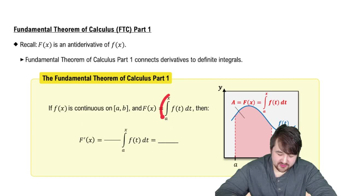
Fundamental Theorem of Calculus

The Fundamental Theorem of Calculus links the concept of differentiation and integration, stating that if a function is continuous on an interval, then the integral of its derivative over that interval equals the change in the function's values at the endpoints. This theorem is crucial for evaluating definite integrals and understanding the relationship between a function and its antiderivative.
Video consigliato:
Percorso guidato
06:11
Fundamental Theorem of Calculus Part 1

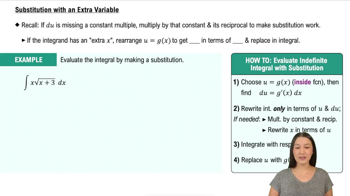
Integration by Substitution

Integration by substitution is a technique used to simplify the process of integration. It involves changing the variable of integration to make the integral easier to solve. This method is particularly useful when dealing with composite functions, as it allows us to express the integral in terms of a single variable, making it more manageable.
Video consigliato:
04:27
Substitution With an Extra Variable

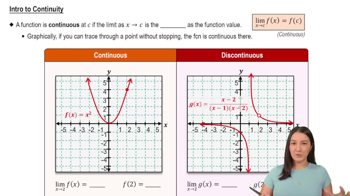
Continuous Functions

A function is considered continuous if there are no breaks, jumps, or holes in its graph. For a function to be continuous at a point, the limit of the function as it approaches that point must equal the function's value at that point. Continuity is essential in calculus because many theorems, including the Fundamental Theorem of Calculus, require the functions involved to be continuous over the interval of integration.
Video consigliato:
05:34
Intro to Continuity
Pratica correlata
Domanda del libro di testo

{Use of Tech} Approximating net area The following functions are positive and negative on the given interval.

ƒ(𝓍) = tan⁻¹ (3x - 1) on [0,1]

(b) Approximate the net area bounded by the graph of f and the x-axis on the interval using a left, right, and midpoint Riemann sum with n = 4.

65
views
Domanda del libro di testo

Using properties of integrals Use the value of the first integral I to evaluate the two given integrals. 

I = ∫₀^π/2 (cos θ ― 2 sin θ) dθ = ―1

(b) ∫₀^π/2 (4 cos θ ― 8 sin θ) dθ

77
views
Domanda del libro di testo

Substitutions Suppose ƒ is an even function with ∫₀⁸ ƒ(𝓍) d𝓍 = 9 . Evaluate each integral.                                                                                                       

(b) ∫²₋₂ 𝓍²ƒ(𝓍³) d𝓍

44
views
Domanda del libro di testo

Area functions for constant functions Consider the following functions ƒ and real numbers a (see figure).

(b) Verify that .A'(𝓍) = ƒ(𝓍)


ƒ(t) = 5 , a = -5

62
views
Domanda del libro di testo

Generalizing the Mean Value Theorem for Integrals Suppose ƒ and g are continuous on [a, b] and let h(𝓍) = (𝓍―b) ∫ₐˣ ƒ(t) dt + (𝓍―a) ∫ₓᵇg(t)dt.                                                                                                                                                                                                                                                                                                                                

(b) Show that there is a number c in (a, b) such that ∫ₐᶜ ƒ(t) dt = ƒ(c) (b ― c)                                                                                                              


(Source: The College Mathematics Journal, 33, 5, Nov 2002)

53
views
Domanda del libro di testo

Explain why or why not Determine whether the following statements are true and give an explanation or counterexample.                                                                          

                                                                                                                                                                                     (b) Suppose ƒ is a negative increasing function, for 𝓍 > 0 . Then the area function A(𝓍) = ∫₀ˣ ƒ(t) dt is a decreasing function of 𝓍 .

60
views