Ch. 5 - Integration
Briggs - Calculus: Early Transcendentals 3rd Edition
Briggs3rd EditionCalculus: Early TranscendentalsISBN: 9780136847243Non è quello che usi tu?Cambia libro di testo
Capitolo 5, Problema 5.2.37

Identifying definite integrals as limits of sums Consider the following limits of Riemann sums for a function ƒ on [a,b]. Identify ƒ and express the limit as a definite integral.                                
          n                                                                                                                                                                              
    lim   ∑   𝓍*ₖ (ln 𝓍*ₖ) ∆𝓍ₖ on [1,2]                                                                                                                                                                            
  ∆ → 0   k=1                                                                                                                                                                                                                      

Guida verificata passo dopo passo
1
Step 1: Recognize the structure of the given limit. The expression lim ∑ 𝓍ₖ (ln 𝓍ₖ) ∆𝓍ₖ as ∆ → 0 is a Riemann sum. A Riemann sum approximates the area under a curve by summing up small rectangles, and as the width of these rectangles (∆𝓍ₖ) approaches zero, the sum converges to a definite integral.
Step 2: Identify the interval of integration. The problem specifies the interval [1, 2], which means the definite integral will be evaluated over this range.
Step 3: Determine the function ƒ(𝓍) being integrated. In the Riemann sum, the term 𝓍ₖ (ln 𝓍ₖ) corresponds to the function ƒ(𝓍) = 𝓍 ln(𝓍). This is the function that will be integrated.
Step 4: Write the definite integral. The limit of the Riemann sum can be expressed as the definite integral of ƒ(𝓍) = 𝓍 ln(𝓍) over the interval [1, 2]. Using proper notation, this is written as: ∫a1b2x⁡ln⁡xdx
Step 5: Conclude the process. The definite integral ∫a1b2x⁡ln⁡xdx represents the limit of the given Riemann sum as ∆ → 0. This integral can now be evaluated using standard techniques of integration, if needed.

Risposta video verificata per un problema simile:

Questa soluzione video è stata consigliata dai nostri tutor come utile per risolvere questo problema.
Durata del video:
2m

Concetti chiave

Ecco i concetti essenziali che devi comprendere per rispondere correttamente alla domanda.

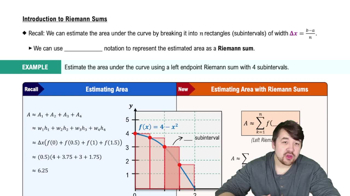
Riemann Sums

Riemann sums are a method for approximating the definite integral of a function over an interval by dividing the interval into smaller subintervals. For each subinterval, a sample point is chosen, and the function's value at that point is multiplied by the width of the subinterval. As the number of subintervals increases and their width decreases, the Riemann sum approaches the exact value of the definite integral.
Video consigliato:
Percorso guidato
06:11
Introduction to Riemann Sums

Definite Integrals

A definite integral represents the signed area under a curve defined by a function over a specific interval [a, b]. It is denoted as ∫[a,b] f(x) dx and can be interpreted as the limit of Riemann sums as the number of subintervals approaches infinity. Definite integrals have numerous applications in calculating areas, volumes, and solving problems in physics and engineering.
Video consigliato:
Percorso guidato
05:43
Definition of the Definite Integral

Limits

In calculus, a limit describes the behavior of a function as its input approaches a certain value. Limits are fundamental in defining both derivatives and integrals. In the context of Riemann sums, the limit is taken as the width of the subintervals approaches zero, allowing for the transition from a sum of areas of rectangles to the exact area under the curve, represented by the definite integral.
Video consigliato:
05:50
One-Sided Limits
Pratica correlata
Domanda del libro di testo

Definite integrals Use a change of variables or Table 5.6 to evaluate the following definite integrals.                                                                                                                         


 ∫₀¹ 2e²ˣ d𝓍

74
views

Domanda del libro di testo

Approximating displacement The velocity of an object is given by the following functions on a specified interval. Approximate the displacement of the object on this interval by subdividing the interval into n subintervals. Use the left endpoint of each subinterval to compute the height of the rectangles.

v = [1 / (2t + 1)] (m/s), for 0 ≤ t ≤ 8 ; n = 4

52
views
Domanda del libro di testo

{Use of Tech} Areas of regions Find the area of the region 𝑅 bounded by the graph of ƒ and the 𝓍-axis on the given interval. Graph ƒ and show the region 𝑅.                                              


 ƒ(𝓍) = 2 ― |𝓍| on [ ― 2 , 4]

74
views
Domanda del libro di testo

Limits of sums Use the definition of the definite integral to evaluate the following definite integrals. Use right Riemann sums and Theorem 5.1.


∫₃⁷ (4𝓍 + 6) d𝓍

104
views
Domanda del libro di testo

Identifying Riemann sums Fill in the blanks with an interval and a value of n.


4

∑ ƒ (1.5 + k) • 1 is a midpoint Riemann sum for f on the interval [ ___ , ___ ]

k = 1

with n = ________ .

63
views
Domanda del libro di testo

Definite integrals Use a change of variables or Table 5.6 to evaluate the following definite integrals.                                                                                                                         


 ∫π/₄^π/² (cos 𝓍) / (sin² 𝓍) d𝓍

70
views