Ch. 5 - Integration
Briggs - Calculus: Early Transcendentals 3rd Edition
Briggs3rd EditionCalculus: Early TranscendentalsISBN: 9780136847243Non è quello che usi tu?Cambia libro di testo
Capitolo 5, Problema 5.3.103

{Use of Tech} Areas of regions Find the area of the region 𝑅 bounded by the graph of ƒ and the 𝓍-axis on the given interval. Graph ƒ and show the region 𝑅.                                              
                                                                                                                                                                                    
 ƒ(𝓍) = 2 ― |𝓍| on [ ― 2 , 4]

Guida verificata passo dopo passo
1
Step 1: Understand the problem. The goal is to find the area of the region R bounded by the graph of ƒ(x) = 2 - |x| and the x-axis over the interval [-2, 4]. This involves integrating the function ƒ(x) over the given interval.
Step 2: Break the function ƒ(x) = 2 - |x| into piecewise components because the absolute value function |x| behaves differently for x < 0 and x ≥ 0. For x < 0, |x| = -x, and for x ≥ 0, |x| = x. Rewrite ƒ(x) as: ƒ(x) = 2 - (-x) = 2 + x for x in [-2, 0], and ƒ(x) = 2 - x for x in [0, 4].
Step 3: Set up the integral to calculate the area. Since the function changes at x = 0, split the integral into two parts: ∫[−2,0](2 + x) dx + ∫[0,4](2 − x) dx.
Step 4: Compute each integral separately. For the first integral ∫[−2,0](2 + x) dx, use the power rule and evaluate the definite integral. For the second integral ∫[0,4](2 − x) dx, similarly apply the power rule and evaluate the definite integral.
Step 5: Add the results of the two integrals to find the total area of the region R. Ensure that any negative values from the integrals are treated as positive since area is always non-negative.

Risposta video verificata per un problema simile:

Questa soluzione video è stata consigliata dai nostri tutor come utile per risolvere questo problema.
Durata del video:
2m

Concetti chiave

Ecco i concetti essenziali che devi comprendere per rispondere correttamente alla domanda.

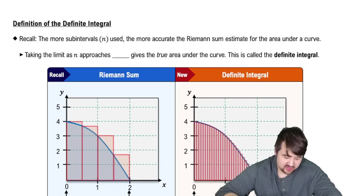
Definite Integral

The definite integral of a function over a specified interval represents the net area between the graph of the function and the x-axis. It is calculated using the Fundamental Theorem of Calculus, which connects differentiation and integration. The area can be positive or negative depending on whether the function is above or below the x-axis, and the definite integral provides a precise numerical value for this area.
Video consigliato:
Percorso guidato
05:43
Definition of the Definite Integral

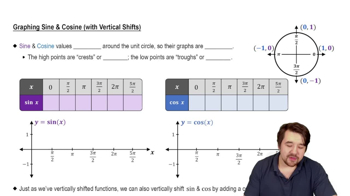
Graphing Functions

Graphing a function involves plotting its values on a coordinate system, which visually represents the relationship between the input (x-values) and output (f(x)-values). For the function ƒ(x) = 2 - |x|, the graph will show a V-shape, indicating how the function behaves over the interval [-2, 4]. Understanding the graph is crucial for identifying the bounded region and calculating the area accurately.
Video consigliato:
Percorso guidato
5:53
Graph of Sine and Cosine Function

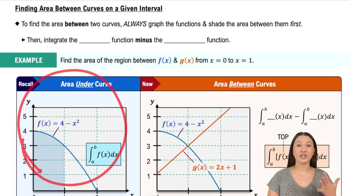
Area Between Curves

The area between a curve and the x-axis can be found by integrating the function over the specified interval. If the function dips below the x-axis, the area is considered negative, and adjustments may be needed to find the total area. In this case, the area of region R is determined by integrating the function ƒ(x) = 2 - |x| from -2 to 4, ensuring to account for any sections below the x-axis.
Video consigliato:
05:23
Finding Area Between Curves on a Given Interval
Pratica correlata
Domanda del libro di testo

Definite integrals Use a change of variables or Table 5.6 to evaluate the following definite integrals.                                                                                                                         


 ∫₀¹ 2e²ˣ d𝓍

74
views

Domanda del libro di testo

Approximating displacement The velocity of an object is given by the following functions on a specified interval. Approximate the displacement of the object on this interval by subdividing the interval into n subintervals. Use the left endpoint of each subinterval to compute the height of the rectangles.

v = [1 / (2t + 1)] (m/s), for 0 ≤ t ≤ 8 ; n = 4

52
views
Domanda del libro di testo

Limits of sums Use the definition of the definite integral to evaluate the following definite integrals. Use right Riemann sums and Theorem 5.1.


∫₃⁷ (4𝓍 + 6) d𝓍

104
views
Domanda del libro di testo

Identifying definite integrals as limits of sums Consider the following limits of Riemann sums for a function ƒ on [a,b]. Identify ƒ and express the limit as a definite integral.                                

          n                                                                                                                                                                              

    lim   ∑   𝓍*ₖ (ln 𝓍*ₖ) ∆𝓍ₖ on [1,2]                                                                                                                                                                            

  ∆ → 0   k=1                                                                                                                                                                                                                      

77
views
Domanda del libro di testo

Definite integrals Use a change of variables or Table 5.6 to evaluate the following definite integrals.                                                                                                                         


 ∫₁³ ( 2ˣ / 2ˣ + 4 ) d𝓍

42
views
Domanda del libro di testo

Definite integrals Use a change of variables or Table 5.6 to evaluate the following definite integrals.                                                                                                                         


 ∫π/₄^π/² (cos 𝓍) / (sin² 𝓍) d𝓍

70
views