

Ch. 5 - Integration
Briggs - Calculus: Early Transcendentals 3rd Edition
Briggs3rd EditionCalculus: Early TranscendentalsISBN: 9780136847243Non è quello che usi tu?Cambia libro di testo
Capitolo 5, Problema 5.2.55a

Properties of integrals Consider two functions ƒ and g on [1,6] such that ∫₁⁶ƒ(𝓍) d𝓍 = 10 and ∫₁⁶g(𝓍) d𝓍 = 5, ∫₄⁶ƒ(𝓍) d𝓍 = 5 , and ∫₁⁴g(𝓍) d𝓍 = 2. Evaluate the following integrals.


(a) ∫₁⁴ 3f(𝓍) d𝓍

Guida verificata passo dopo passo
1
Step 1: Recall the property of integrals that allows constants to be factored out. Specifically, for any constant c and function ƒ(𝓍), ∫ₐᵇ cƒ(𝓍) d𝓍 = c∫ₐᵇ ƒ(𝓍) d𝓍.
Step 2: Apply this property to the given integral ∫₁⁴ 3ƒ(𝓍) d𝓍. Factor out the constant 3, so the integral becomes 3∫₁⁴ ƒ(𝓍) d𝓍.
Step 3: Notice that the integral ∫₁⁴ ƒ(𝓍) d𝓍 is not directly provided in the problem. However, you can calculate it using the additive property of integrals: ∫₁⁶ ƒ(𝓍) d𝓍 = ∫₁⁴ ƒ(𝓍) d𝓍 + ∫₄⁶ ƒ(𝓍) d𝓍.
Step 4: Substitute the known values into the equation. From the problem, ∫₁⁶ ƒ(𝓍) d𝓍 = 10 and ∫₄⁶ ƒ(𝓍) d𝓍 = 5. Solve for ∫₁⁴ ƒ(𝓍) d𝓍 by subtracting: ∫₁⁴ ƒ(𝓍) d𝓍 = 10 - 5.
Step 5: Replace ∫₁⁴ ƒ(𝓍) d𝓍 in the expression 3∫₁⁴ ƒ(𝓍) d𝓍 with the calculated value from Step 4. The final integral is now expressed as 3 multiplied by the result of ∫₁⁴ ƒ(𝓍) d𝓍.

Risposta video verificata per un problema simile:

Questa soluzione video è stata consigliata dai nostri tutor come utile per risolvere questo problema.
Durata del video:
2m

Concetti chiave

Ecco i concetti essenziali che devi comprendere per rispondere correttamente alla domanda.

Properties of Definite Integrals

Definite integrals have several key properties, including linearity, which states that the integral of a sum of functions is the sum of their integrals. Additionally, the integral of a constant multiplied by a function can be factored out, allowing for simplification in calculations. Understanding these properties is essential for evaluating integrals efficiently.
Video consigliato:
Percorso guidato
05:43
Definition of the Definite Integral

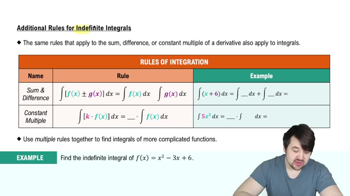
Integration of Constant Multiples

When integrating a function multiplied by a constant, the constant can be factored out of the integral. For example, ∫ₐᵇ kƒ(𝓍) d𝓍 = k∫ₐᵇ ƒ(𝓍) d𝓍, where k is a constant. This property simplifies the evaluation of integrals, making it easier to compute the area under the curve of the function multiplied by a constant.
Video consigliato:
Percorso guidato
05:56
Additional Rules for Indefinite Integrals

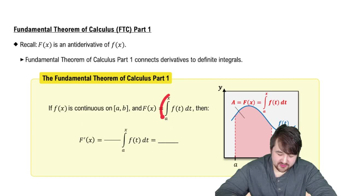
Fundamental Theorem of Calculus

The Fundamental Theorem of Calculus connects differentiation and integration, stating that if F is an antiderivative of f on an interval [a, b], then ∫ₐᵇ f(𝓍) d𝓍 = F(b) - F(a). This theorem is crucial for evaluating definite integrals and understanding the relationship between a function and its integral over a specified interval.
Video consigliato:
Percorso guidato
06:11
Fundamental Theorem of Calculus Part 1
Pratica correlata
Domanda del libro di testo

Bounds on an integral Suppose ƒ is continuous on [a, b] with ƒ''(𝓍) > 0 on the interval. It can be shown that (b―a) ƒ [(a + b) /2] ≤ ∫ₐᵇ ƒ(𝓍) d𝓍 ≤ (b―a) [ (ƒ(a) + ƒ(b)) /2]                                                         


(a) Assuming ƒ is nonnegative on [a, b], draw a figure to illustrate the geometric meaning of these inequalities. Discuss your conclusions. b. 

55
views
Domanda del libro di testo

{Use of Tech} Approximating definite integrals with a calculator Consider the following definite integrals.

(a) Write the left and right Riemann sums in sigma notation for an arbitrary value of n.


∫₀¹ cos ⁻¹ 𝓍 d𝓍

57
views
Domanda del libro di testo

The velocity in ft/s of an object moving along a line is given by v = ƒ(t) on the interval 0 ≤ t ≤ 8 (see figure), where t is measured in seconds.

a) Divide the interval [0,8] into n = 2 subintervals, [0,4] and [4,8]. On each subinterval, assume the object moves at a constant velocity equal to the value of v evaluated at the midpoint of the subinterval, and use these approximations to estimate the displacement of the object on [0,8] (see part (a) of the figure)                                                                                                             


89
views
Domanda del libro di testo

Working with area functions Consider the function ƒ and the points a, b, and c.

(a) Find the area function A (𝓍) = ∫ₐˣ ƒ(t) dt using the Fundamental Theorem.

ƒ(𝓍) = ― 12𝓍 (𝓍―1) (𝓍― 2) ; a = 0 , b = 1 , c = 2

51
views
Domanda del libro di testo

The velocity in ft/s of an object moving along a line is given by v = ƒ(t) on the interval 0 ≤ t ≤ 6 (see figure), where t is measured in seconds.


(a) Divide the interval [0,6] into n = 3 subintervals, [0,2] , [2,4] and [4,6]. On each subinterval, assume the object moves at a constant velocity equal to the value of v evaluated at the right endpoint of the subinterval, and use these approximations to estimate the displacement of the object on [0,6] (see part (a) of the figure)                                                                                                             


67
views
Domanda del libro di testo

Area functions for constant functions Consider the following functions ƒ and real numbers a (see figure).

(a) Find and graph the area function A(𝓍) = ∫ₐˣ ƒ(t) dt for ƒ.

ƒ(t) = 5 , a = 0

108
views