Ch. 5 - Integration
Briggs - Calculus: Early Transcendentals 3rd Edition
Briggs3rd EditionCalculus: Early TranscendentalsISBN: 9780136847243Non è quello che usi tu?Cambia libro di testo
Capitolo 5, Problema 5.1.5a

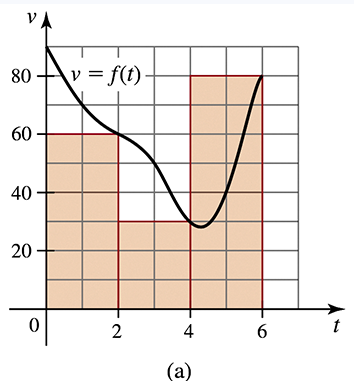
The velocity in ft/s of an object moving along a line is given by v = ƒ(t) on the interval 0 ≤ t ≤ 6 (see figure), where t is measured in seconds.


(a) Divide the interval [0,6] into n = 3 subintervals, [0,2] , [2,4] and [4,6]. On each subinterval, assume the object moves at a constant velocity equal to the value of v evaluated at the right endpoint of the subinterval, and use these approximations to estimate the displacement of the object on [0,6] (see part (a) of the figure)                                                                                                             
                                                                                                                                                                                                
fig1

Guida verificata passo dopo passo
1
Divide the interval [0,6] into three subintervals: [0,2], [2,4], and [4,6].
For each subinterval, determine the velocity at the right endpoint by evaluating the graph of v = f(t). For [0,2], the right endpoint is t=2; for [2,4], the right endpoint is t=4; and for [4,6], the right endpoint is t=6.
Approximate the displacement on each subinterval by multiplying the velocity at the right endpoint by the length of the subinterval. For example, for [0,2], the displacement is v(2) * (2-0). Repeat this for [2,4] and [4,6].
Add the displacements from all three subintervals to estimate the total displacement of the object on [0,6].
Ensure that the units of the final displacement are consistent (e.g., ft) since velocity is given in ft/s and time in seconds.

Risposta video verificata per un problema simile:

Questa soluzione video è stata consigliata dai nostri tutor come utile per risolvere questo problema.
Durata del video:
3m

Concetti chiave

Ecco i concetti essenziali che devi comprendere per rispondere correttamente alla domanda.

Velocity Function

The velocity function, denoted as v = f(t), describes how the velocity of an object changes over time. In this context, it provides the speed of the object at any given moment t within the specified interval. Understanding this function is crucial for estimating displacement, as it directly influences how far the object travels during each subinterval.
Video consigliato:
Percorso guidato
10:17
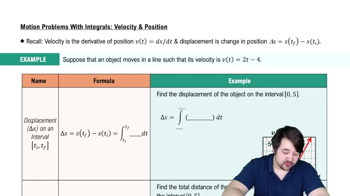
Using The Velocity Function

Subintervals

Subintervals are smaller segments into which a larger interval is divided for analysis. In this problem, the interval [0, 6] is divided into three subintervals: [0, 2], [2, 4], and [4, 6]. This division allows for the approximation of displacement by evaluating the velocity at the right endpoint of each subinterval, simplifying the calculation of the total distance traveled.
Video consigliato:
Percorso guidato
06:11
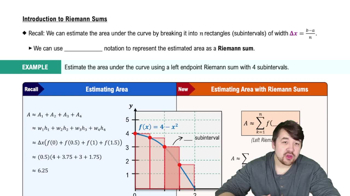
Introduction to Riemann Sums

Riemann Sum

A Riemann sum is a method for approximating the total area under a curve, which in this case represents the displacement of the object. By using the right endpoint of each subinterval to determine the height of rectangles, the sum of the areas of these rectangles provides an estimate of the total displacement over the interval [0, 6]. This concept is fundamental in calculus for understanding integration and area calculations.
Video consigliato:
Percorso guidato
06:11
Introduction to Riemann Sums
Pratica correlata
Domanda del libro di testo

Properties of integrals Consider two functions ƒ and g on [1,6] such that ∫₁⁶ƒ(𝓍) d𝓍 = 10 and ∫₁⁶g(𝓍) d𝓍 = 5, ∫₄⁶ƒ(𝓍) d𝓍 = 5 , and ∫₁⁴g(𝓍) d𝓍 = 2. Evaluate the following integrals.


(a) ∫₁⁴ 3f(𝓍) d𝓍

61
views

Domanda del libro di testo

The velocity in ft/s of an object moving along a line is given by v = ƒ(t) on the interval 0 ≤ t ≤ 8 (see figure), where t is measured in seconds.

a) Divide the interval [0,8] into n = 2 subintervals, [0,4] and [4,8]. On each subinterval, assume the object moves at a constant velocity equal to the value of v evaluated at the midpoint of the subinterval, and use these approximations to estimate the displacement of the object on [0,8] (see part (a) of the figure)                                                                                                             


89
views
Domanda del libro di testo

Working with area functions Consider the function ƒ and the points a, b, and c.

(a) Find the area function A (𝓍) = ∫ₐˣ ƒ(t) dt using the Fundamental Theorem.

ƒ(𝓍) = ― 12𝓍 (𝓍―1) (𝓍― 2) ; a = 0 , b = 1 , c = 2

51
views
Domanda del libro di testo

Working with area functions Consider the function ƒ and its graph.

(a) Estimate the zeros of the area function A(𝓍) = ∫₀ˣ ƒ(t) dt , for 0 ≤ 𝓍 ≤ 10 .


36
views
Domanda del libro di testo

Sigma notation Express the following sums using sigma notation. (Answers are not unique.)

(a) 1 + 2 + 3 + 4 + 5

110
views
Domanda del libro di testo

Using properties of integrals Use the value of the first integral I to evaluate the two given integrals. 

I = ∫₀^π/2 (cos θ ― 2 sin θ) dθ = ―1

(a) ∫₀^π/2 (2 sin θ ― cos θ) dθ

82
views