Ch. 5 - Integration
Briggs - Calculus: Early Transcendentals 3rd Edition
Briggs3rd EditionCalculus: Early TranscendentalsISBN: 9780136847243Non è quello che usi tu?Cambia libro di testo
Capitolo 5, Problema 5.4.18

Symmetry in integrals Use symmetry to evaluate the following integrals.
∫₋π/₂^π/² 5 sin θ dθ

Guida verificata passo dopo passo
1
Recognize that the integral involves a symmetric interval about zero: [-π/2, π/2]. This symmetry can simplify the evaluation process.
Observe the integrand, 5 sin(θ). The function sin(θ) is odd, meaning sin(-θ) = -sin(θ). This property is crucial for determining the behavior of the integral over symmetric intervals.
Use the property of odd functions: When integrating an odd function over a symmetric interval about zero, the integral evaluates to zero. This is because the positive and negative contributions cancel each other out.
Conclude that the integral ∫₋π/₂^π/₂ 5 sin(θ) dθ equals zero due to the symmetry and the odd nature of sin(θ).
No further computation is needed, as the symmetry property directly provides the result.

Risposta video verificata per un problema simile:

Questa soluzione video è stata consigliata dai nostri tutor come utile per risolvere questo problema.
Durata del video:
1m

Concetti chiave

Ecco i concetti essenziali che devi comprendere per rispondere correttamente alla domanda.

Symmetry in Integrals

Symmetry in integrals refers to the property that allows certain integrals to be simplified based on the symmetry of the function being integrated. If a function is even (symmetric about the y-axis), the integral from -a to a can be computed as twice the integral from 0 to a. If the function is odd (symmetric about the origin), the integral over a symmetric interval around zero is zero.
Video consigliato:
Percorso guidato
06:18
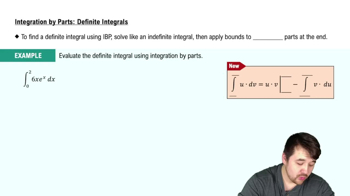
Integration by Parts for Definite Integrals

Trigonometric Functions

Trigonometric functions, such as sine and cosine, are fundamental in calculus, especially in integrals involving angles. The sine function, sin(θ), is periodic and has specific properties, such as being odd, which means sin(-θ) = -sin(θ). Understanding these properties is crucial for evaluating integrals that involve trigonometric functions.
Video consigliato:
Percorso guidato
6:04
Introduction to Trigonometric Functions

Definite Integrals

A definite integral calculates the area under a curve defined by a function over a specific interval [a, b]. It is represented as ∫_a^b f(x) dx and provides a numerical value. Evaluating definite integrals often involves techniques such as substitution, integration by parts, or leveraging symmetry, which can simplify the computation significantly.
Video consigliato:
Percorso guidato
05:43
Definition of the Definite Integral
Pratica correlata
Domanda del libro di testo

Definite integrals Evaluate the following integrals using the Fundamental Theorem of Calculus


∫₋₂⁻¹ 𝓍⁻³ d𝓍

86
views

Domanda del libro di testo

Identifying definite integrals as limits of sums Consider the following limits of Riemann sums for a function ƒ on [a,b]. Identify ƒ and express the limit as a definite integral.                                

          n                                                                                                                                                                              

    lim   ∑   𝓍*ₖ (ln 𝓍*ₖ) ∆𝓍ₖ on [1,2]                                                                                                                                                                            

  ∆ → 0   k=1                                                                                                                                                                                                                      

77
views
Domanda del libro di testo

{Use of Tech} Sigma notation for Riemann sums Use sigma notation to write the following Riemann sums. Then evaluate each Riemann sum using Theorem 5.1 or a calculator.

The midpoint Riemann sum for f(x) = x³ on [3,11] with n = 32.

83
views
Domanda del libro di testo

Symmetry in integrals Use symmetry to evaluate the following integrals.

∫₋π/₄^π/⁴ sec² x dx

95
views
Domanda del libro di testo

Indefinite integrals Use a change of variables or Table 5.6 to evaluate the following indefinite integrals. Check your work by differentiating.                                                                                  


 ∫ d𝓍 / (√1 ― 9𝓍²)

92
views
Domanda del libro di testo

Multiple substitutions If necessary, use two or more substitutions to find the following integrals.                                                                                    


  ∫ d𝓍 / [√1 + √(1 + 𝓍)] (Hint: Begin with u = √(1 + 𝓍 .)  

119
views