
Ch. 5 - Integration
Briggs - Calculus: Early Transcendentals 3rd Edition
Briggs3rd EditionCalculus: Early TranscendentalsISBN: 9780136847243Non è quello che usi tu?Cambia libro di testo
Capitolo 5, Problema 5.5.12

Use a substitution of the form u = a𝓍 + b to evaluate the following indefinite integrals
∫(e³ˣ ⁺¹ d𝓍

Guida verificata passo dopo passo
1
Recognize that the integral involves an exponential function with a linear term in the exponent. To simplify, use the substitution u = 3𝓍 + 1, where a = 3 and b = 1.
Differentiate the substitution u = 3𝓍 + 1 with respect to 𝓍 to find du/d𝓍 = 3, or equivalently, du = 3 d𝓍.
Solve for d𝓍 in terms of du: d𝓍 = du/3. Substitute this and u into the integral, replacing 3𝓍 + 1 with u and d𝓍 with du/3.
The integral now becomes ∫e^u (du/3). Factor out the constant 1/3 to simplify the expression to (1/3) ∫e^u du.
Evaluate the integral of e^u, which is simply e^u. Replace u with the original substitution 3𝓍 + 1 to return to the variable 𝓍. The final result will include a constant of integration, C.

Risposta video verificata per un problema simile:

Questa soluzione video è stata consigliata dai nostri tutor come utile per risolvere questo problema.
Durata del video:
2m

Concetti chiave

Ecco i concetti essenziali che devi comprendere per rispondere correttamente alla domanda.

Substitution Method in Integration

The substitution method is a technique used in calculus to simplify the process of integration. By substituting a part of the integrand with a new variable, it transforms the integral into a more manageable form. This method is particularly useful when dealing with composite functions, allowing for easier integration by changing the variable of integration.
Video consigliato:
07:33
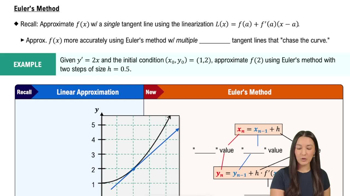
Euler's Method

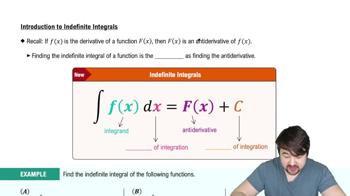
Indefinite Integrals

Indefinite integrals represent a family of functions whose derivative is the integrand. They are expressed without limits of integration and include a constant of integration, typically denoted as 'C'. Understanding indefinite integrals is crucial for finding antiderivatives and solving differential equations, as they provide the general solution to integration problems.
Video consigliato:
Percorso guidato
05:04
Introduction to Indefinite Integrals

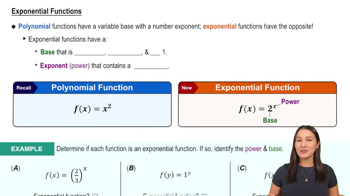
Exponential Functions

Exponential functions are mathematical functions of the form f(x) = e^(kx), where 'e' is the base of natural logarithms and 'k' is a constant. These functions are characterized by their rapid growth and unique properties, such as the fact that their derivative is proportional to the function itself. Recognizing the behavior of exponential functions is essential for evaluating integrals involving them, particularly in the context of substitution.
Video consigliato:
6:13
Exponential Functions
Pratica correlata
Domanda del libro di testo

{Use of Tech} Sigma notation for Riemann sums Use sigma notation to write the following Riemann sums. Then evaluate each Riemann sum using Theorem 5.1 or a calculator.

The right Riemann sum for ƒ(𝓍)) = x + 1 on [0, 4] with n = 50.

95
views
Domanda del libro di testo

Average distance on a triangle Consider the right triangle with vertices (0,0) ,(0,b) , and (a,0) , where a > 0 and b > 0. Show that the average vertical distance from points on the 𝓍-axis to the hypotenuse is b/2 , for all a > 0 .

49
views
Domanda del libro di testo

Definite integrals Evaluate the following integrals using the Fundamental Theorem of Calculus


∫¹₁/₂ (t⁻³ ― 8) dt

58
views
Domanda del libro di testo

Derivatives of integrals Simplify the following expressions.


d/dy ∫¹⁰ᵧ³ √(𝓍⁶ + 1) d𝓍

118
views
Domanda del libro di testo

Definite integrals Use a change of variables or Table 5.6 to evaluate the following definite integrals.                                                                                                                         


 ∫π/₁₆^π/⁸ 8 csc² 4𝓍 d𝓍

100
views
Domanda del libro di testo

Areas of regions Find the area of the following regions.                                                                                                                   

                                                                                                                                                                 The region bounded by the graph of ƒ(𝓍) = (𝓍―4)⁴ and the 𝓍-axis between and 𝓍 = 2 and 𝓍= 6

63
views