Ch. 5 - Integration
Briggs - Calculus: Early Transcendentals 3rd Edition
Briggs3rd EditionCalculus: Early TranscendentalsISBN: 9780136847243Non è quello che usi tu?Cambia libro di testo
Capitolo 5, Problema 5.2.23b

{Use of Tech} Approximating net area The following functions are positive and negative on the given interval.


f(x) = sin 2x on [0,3π/4]


(b) Approximate the net area bounded by the graph of f and the x-axis on the interval using a left, right, and midpoint Riemann sum with n = 4.

Guida verificata passo dopo passo
1
Step 1: Understand the problem. You are tasked with approximating the net area bounded by the graph of f(x) = sin(2x) and the x-axis on the interval [0, 3π/4] using three types of Riemann sums: left, right, and midpoint, with n = 4 subintervals.
Step 2: Divide the interval [0, 3π/4] into n = 4 equal subintervals. The width of each subinterval, Δx, is calculated as Δx = (3π/4 - 0)/4 = 3π/16.
Step 3: For the left Riemann sum, use the left endpoints of each subinterval to evaluate f(x). The left endpoints are x₀ = 0, x₁ = 3π/16, x₂ = 6π/16, and x₃ = 9π/16. Compute the sum: Left Sum ≈ Δx * [f(x₀) + f(x₁) + f(x₂) + f(x₃)].
Step 4: For the right Riemann sum, use the right endpoints of each subinterval to evaluate f(x). The right endpoints are x₁ = 3π/16, x₂ = 6π/16, x₃ = 9π/16, and x₄ = 12π/16. Compute the sum: Right Sum ≈ Δx * [f(x₁) + f(x₂) + f(x₃) + f(x₄)].
Step 5: For the midpoint Riemann sum, use the midpoints of each subinterval to evaluate f(x). The midpoints are x₁ = (0 + 3π/16)/2, x₂ = (3π/16 + 6π/16)/2, x₃ = (6π/16 + 9π/16)/2, and x₄ = (9π/16 + 12π/16)/2. Compute the sum: Midpoint Sum ≈ Δx * [f(x₁) + f(x₂) + f(x₃) + f(x₄)].

Risposta video verificata per un problema simile:

Questa soluzione video è stata consigliata dai nostri tutor come utile per risolvere questo problema.
Durata del video:
5m

Concetti chiave

Ecco i concetti essenziali che devi comprendere per rispondere correttamente alla domanda.

Riemann Sums

Riemann sums are a method for approximating the definite integral of a function over an interval. They involve dividing the interval into smaller subintervals, calculating the function's value at specific points within these subintervals (left endpoint, right endpoint, or midpoint), and then summing the areas of the rectangles formed. This technique helps estimate the net area under a curve, which is essential for understanding integration.
Video consigliato:
Percorso guidato
06:11
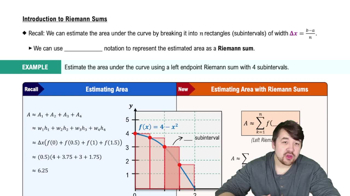
Introduction to Riemann Sums

Definite Integral

The definite integral of a function over an interval provides the net area between the graph of the function and the x-axis. It accounts for both positive and negative areas, where areas above the x-axis contribute positively and those below contribute negatively. Understanding the concept of definite integrals is crucial for interpreting the results of Riemann sums and for calculating exact areas under curves.
Video consigliato:
Percorso guidato
05:43
Definition of the Definite Integral

Trigonometric Functions

Trigonometric functions, such as sine and cosine, are fundamental in calculus, particularly when dealing with periodic functions. The function f(x) = sin(2x) oscillates between -1 and 1, and its behavior on the specified interval [0, 3π/4] affects the calculation of the net area. Recognizing the properties of these functions, including their periodicity and symmetry, is vital for accurately applying Riemann sums.
Video consigliato:
Percorso guidato
6:04
Introduction to Trigonometric Functions