Ch. 5 - Integration
Briggs - Calculus: Early Transcendentals 3rd Edition
Briggs3rd EditionCalculus: Early TranscendentalsISBN: 9780136847243Non è quello che usi tu?Cambia libro di testo
Capitolo 5, Problema 5.5.15a

Use Table 5.6 to evaluate the following indefinite integrals.                                                                                                               
                                                                                                                                                                  
 (a) ∫ e¹⁰ˣ d𝓍

Guida verificata passo dopo passo
1
Step 1: Recognize that the integral involves the exponential function e raised to a linear term (10x). The formula for the integral of e^(kx) is (1/k) * e^(kx) + C, where k is a constant and C is the constant of integration.
Step 2: Identify the constant k in the exponent. In this case, k = 10 because the exponent is 10x.
Step 3: Apply the formula for the integral of e^(kx). Substitute k = 10 into the formula, resulting in (1/10) * e^(10x) + C.
Step 4: Write the result in terms of the indefinite integral. The integral ∫ e^(10x) dx simplifies to (1/10) * e^(10x) + C.
Step 5: Remember to include the constant of integration (C) in your final answer, as this is an indefinite integral.

Risposta video verificata per un problema simile:

Questa soluzione video è stata consigliata dai nostri tutor come utile per risolvere questo problema.
Durata del video:
1m

Concetti chiave

Ecco i concetti essenziali che devi comprendere per rispondere correttamente alla domanda.

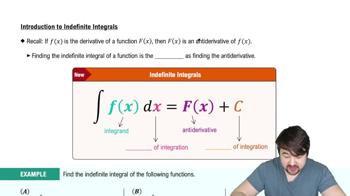
Indefinite Integrals

Indefinite integrals represent a family of functions whose derivative is the integrand. They are expressed with the integral sign followed by the function and the differential, and they include a constant of integration (C) since the derivative of a constant is zero. Understanding how to evaluate indefinite integrals is crucial for solving problems in calculus, as they provide the antiderivative of a function.
Video consigliato:
Percorso guidato
05:04
Introduction to Indefinite Integrals

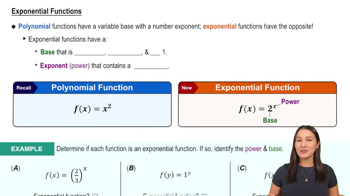
Exponential Functions

Exponential functions are mathematical functions of the form f(x) = a^x, where 'a' is a constant and 'x' is the variable. In calculus, the natural exponential function e^x is particularly important due to its unique property that the derivative of e^x is e^x itself. This property simplifies the process of integration, especially when dealing with integrals involving exponential terms.
Video consigliato:
6:13
Exponential Functions

Integration Techniques

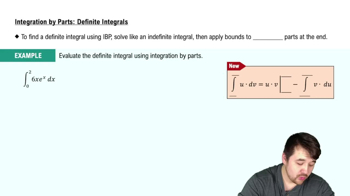
Integration techniques are methods used to evaluate integrals that may not be straightforward. Common techniques include substitution, integration by parts, and using integral tables. Familiarity with these techniques allows students to tackle a variety of integrals, including those involving exponential functions, and is essential for effectively solving calculus problems.
Video consigliato:
Percorso guidato
06:18
Integration by Parts for Definite Integrals
Pratica correlata
Domanda del libro di testo

Displacement from a velocity graph Consider the velocity function for an object moving along a line (see figure).

(a) Describe the motion of the object over the interval [0,6].

76
views

Domanda del libro di testo

Explain why or why not Determine whether the following statements are true and give an explanation or counterexample.

(a) If ƒ is symmetric about the line 𝓍 = 2 , then ∫₀⁴ ƒ(𝓍) d𝓍 = 2 ∫₀² ƒ(𝓍) d𝓍.

64
views
Domanda del libro di testo

Free fall On October 14, 2012, Felix Baumgartner stepped off a balloon capsule at an altitude of almost 39 km above Earth’s surface and began his free fall. His velocity in m/s during the fall is given in the figure. It is claimed that Felix reached the speed of sound 34 seconds into his fall and that he continued to fall at supersonic speed for 30 seconds. (Source: http://www.redbullstratos.com)

(a) Divide the interval [34, 64] into n = 5 subintervals with the gridpoints x₀ = 34 , x₁ = 40 , x₂ = 46 , x₃ = 52 , x₄ = 58 , and x₅ = 64. Use left and right Riemann sums to estimate how far Felix fell while traveling at supersonic speed.

64
views
Domanda del libro di testo

Area functions The graph of ƒ is shown in the figure. Let A(x) = ∫₀ˣ ƒ(t) dt and F(x) = ∫₂ˣ ƒ(t) dt be two area functions for ƒ. Evaluate the following area functions.

(a) A(2)

66
views
Domanda del libro di testo

Area functions for the same linear function Let ƒ(t) = 2t ― 2 and consider the two area functions A (𝓍) = ∫₁ˣ ƒ(t) dt and F(𝓍) = ∫₄ˣ ƒ(t) dt .

(a) Evaluate A (2) and A (3). Then use geometry to find an expression for A (𝓍) , for 𝓍 ≥ 1 .

70
views
Domanda del libro di testo

Planetary orbits The planets orbit the Sun in elliptical orbits with the Sun at one focus (see Section 12.4 for more on ellipses). The equation of an ellipse whose dimensions are 2a in the 𝓍-direction and 2b in the y-direction is (𝓍²/a²) + (y² /b²) = 1.

(a) Let d² denote the square of the distance from a planet to the center of the ellipse at (0, 0). Integrate over the interval [ ―a, a] to show that the average value of d² is (a² + 2b²) /3 .

137
views